About Hyblaea puera (Cramer, 1777)
Hyblaea puera, commonly called the teak defoliator, is a moth that forms a cryptic species complex. It is native to South Asia and Southeast Asia, and was first formally described by Pieter Cramer in 1777. In recent times, the species has also been recorded in Central America and Africa. Its caterpillar feeds on teak and other tree species, and H. puera is ranked as one of the most major teak pests worldwide.
In terms of distribution and habitat, H. puera can be found in forests across southern Asia, ranging from India, Sri Lanka, and Bangladesh through Thailand and the rest of Southeast Asia to New Guinea, and also occurs in north Queensland, Australia. Recent records have documented its presence in Guadeloupe and Suriname.
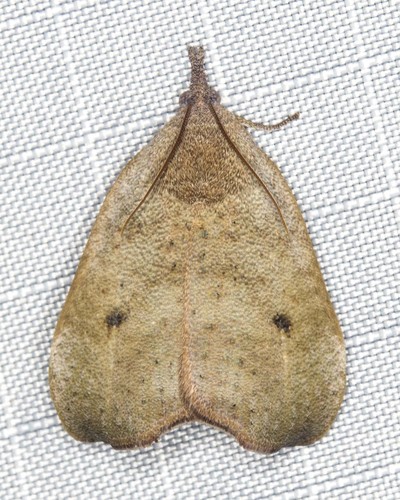
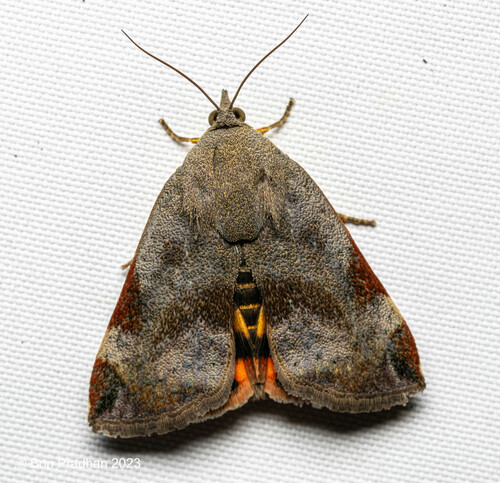
Adult H. puera moths are relatively small, with a wingspan of 3–4 cm. They have a characteristic resting posture that hides their black and orange-yellow hindwings beneath their greyish-brown forewings. Males and females emerge from pupation around the same time, and mating occurs within two days of emergence. Females lay eggs singly near leaf veins on tender new leaves, most often on the leaf undersurface. The eggs are oval, flat, white, and measure roughly 1 mm in length. Each female lays around 500 eggs, with a maximum recorded count of 1000 eggs per individual. Eggs hatch after approximately two days.
There are five larval instars for this species. First and second instar larvae feed primarily on the leaf surface. Beginning in the third instar, larvae cut a leaf flap, usually at the leaf edge, fold the flap over, secure it with silk, and feed from inside this protected space. Larvae eat almost the entire leaf of tender new growth, leaving only the major veins intact; more of the leaf's veins are left uneaten on older leaves. Under optimal conditions, the larval stage lasts 10 to 12 days. When fully grown, larvae measure 3.5–4.5 cm in length. There is notable color variation in fourth and fifth instar larvae: the body may be entirely black, or dark greyish to black, with longitudinal colored bands that can include a dorsal orange or ocherous band and lateral white lines. A recent study has found that H. puera larvae exhibit density-dependent color polyphenism, and build up resistance to invading baculovirus.
When larvae reach maturity, they lower themselves to the ground on silken threads and pupate under a thin layer of leaf litter or soil, inside loose cocoons constructed from silk bound with dry or decayed leaves, or soil particles. Occasionally, pupation may take place inside folded green leaves of undergrowth plants, held together with silk. On Avicennia mangrove plants, caterpillars pupate inside cases made from the host plant's own leaves. This is thought to be an adaptive trait that allows the species to survive the challenging mangrove environment, where pupation in muddy, frequently inundated mangrove soils is not possible. Under optimal conditions, the average pupal stage lasts six to eight days. There is no evidence that pupae enter hibernation or aestivation.
In Indonesia, this moth is called entung jati, and it is commonly eaten by people in regions where it is abundant. Individuals are typically harvested for consumption at the cocoon stage, when they can be easily collected from the ground. For local villagers, most of whom work as farmers, teak defoliator cocoons are an important, easily accessible source of protein.