About Hyalophora cecropia Linnaeus, 1758
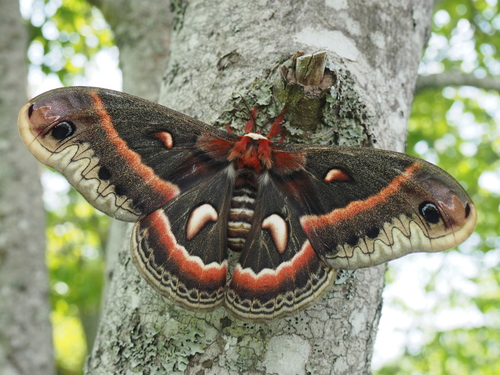
Hyalophora cecropia, commonly called the cecropia moth, is the largest native moth species of North America. It belongs to Saturniidae, the family of giant silk moths. Documented female cecropia moths have a wingspan of 5 to 7 inches (13 to 18 cm) or more. This species is found predominantly across eastern North America; individuals have been recorded as far west as Washington and as far north as most Canadian provinces. Cecropia moth larvae are most commonly found on maple trees, but have also been observed on cherry and birch trees, among many other species. The species was first formally described by Carl Linnaeus in the 10th edition of Systema Naturae, published in 1758. Like other giant silk moths, adult cecropia moths do not have functional mouthparts or a digestive system. Because of this, adults only survive for approximately two weeks. To attract mates, female cecropia moths release pheromones, which males can detect using their sensitive antennae. Males can detect these pheromones from up to one mile away, and may fly as far as 7 miles while searching for a female. Mating usually starts in the early morning and continues until the evening. After mating, females lay up to one hundred eggs. The eggs are mottled reddish brown, and are typically placed on either side of a host plant leaf. The eggs eventually hatch into tiny black caterpillars. Larval development occurs through five instars, or developmental stages, with each stage lasting approximately one week. First instar larvae are black, a coloration that comes from small black hairs growing from tubercles—small projections—covering their entire body. These larvae feed on many common trees and shrubs, including maple, birch, and apple. As caterpillars grow into the second instar, they turn yellow green. In the third, fourth, and fifth instars, the growing caterpillars become bluish green. In these later developmental stages, the tubercles turn blue, yellow, or orange depending on their location on the body, and the original black hairs are eventually lost. Mature caterpillars, reached in autumn, grow to around 4 to 4.5 inches (100 to 110 mm) long. Once mature, caterpillars spin large brown cocoons lengthwise on trees or wooden structures. They then emerge as adults during the first two weeks of warm seasonal weather in early summer. Hyalophora cecropia is univoltine, meaning it produces only one generation per year. Adult cecropia moths have variable size, but are typically quite large, with a wingspan of 5 to 7 inches (130 to 180 mm). Their wings are brownish, with red coloration near the base of the forewing. All four wings have crescent-shaped red spots with whitish centers; these spots are larger on the hindwings. Beyond the postmedial line that runs lengthwise down the center of all four wings, the wings have whitish coloration followed by reddish shaded bands. The moth's body is hairy, with reddish coloration on the anterior portion that fades to a mix of reddish and whitish. The abdomen has alternating bands of red and white.