About Hyalessa maculaticollis (Motschulsky, 1866)
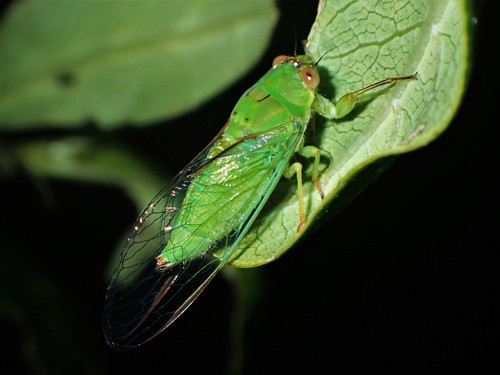
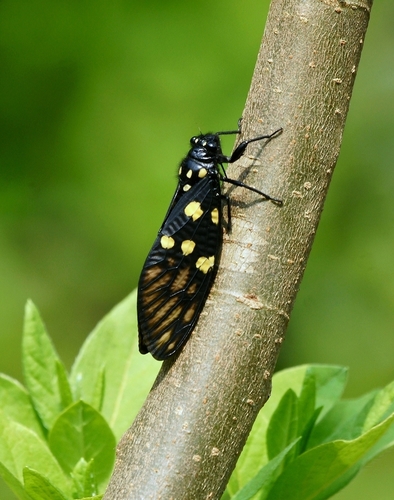
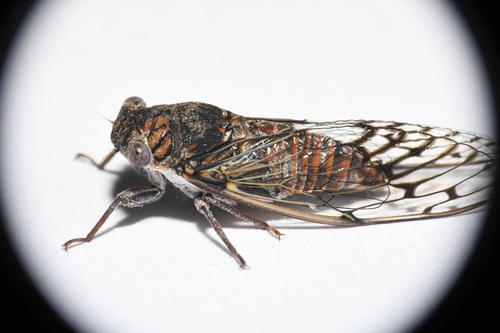
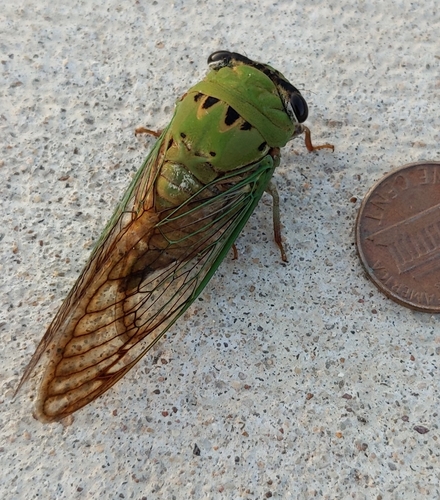
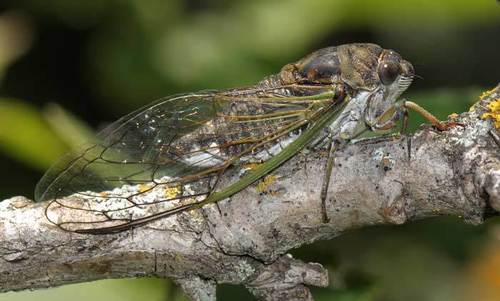
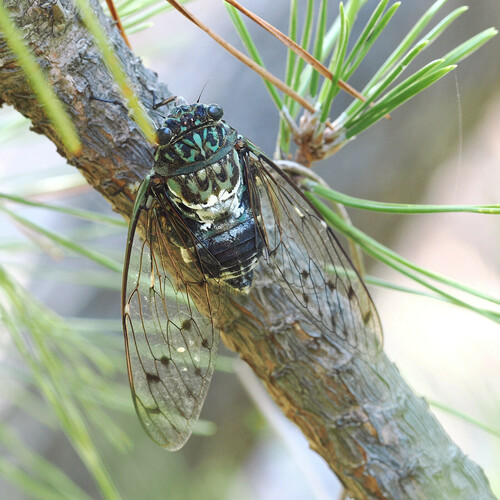
The scientific name of this species is Hyalessa maculaticollis (Motschulsky, 1866). The body color of Hyalessa maculaticollis ranges from green to black, and this variation, along with the species’ calling sound, differs by location. Only male individuals produce calling sounds. The call of Japanese populations of this species sounds like “min—minminminminmi...”, while the call of Korean populations sounds like “maemmaemmaemmaem...mi...”, with longer note durations in the second half of the call. The sound of this species influenced the Korean word for “cicada”, 매미. The calls of Chinese populations are similar to those of Korean populations. Typical adult Hyalessa maculaticollis reach 33–36 mm in body length. They have a narrow head, a thick short abdomen, and an overall egg-shaped body. Their wings are large relative to their body, and are about the same size as the wings of brown cicadas when the full winged body is measured. There is white body coloration near the boundary between the thorax and abdomen; the rest of the body has light blue or green spots on a black background, making its body color relatively bright for a Japanese cicada. Some individuals have almost no black spots and are primarily bluish green; this variant is called mikadominmin (ミカドミンミン). The exoskeleton is dull, and the species is around the same size as brown cicadas. Unlike brown cicadas and Platypleura kaempferi, this species occurs in large populations, similar to Tanna japonensis and Terpnosia nigricosta (エゾハルゼミ). It is abundant in locations including Tokyo, Yokohama City (Kanagawa Prefecture), and Sendai City (Miyagi Prefecture).
Hyalessa maculaticollis is distributed across China, Japan, the Korean Peninsula, and maritime areas of Russia. Populations in Korea, Eastern China, and Far East Russia were previously classified as the separate species Hyalessa fuscata (Distant, 1905), but recent taxonomic data recognizes H. fuscata as a synonym of H. maculaticollis. In Japan, the species is distributed from the Oshima Peninsula in southern Hokkaido south to Honshu, Kyushu, and their surrounding islands, including Tsushima and the Koshiki Islands. Cold northern climate limits its distribution in Japan, confining most populations to central and southern areas of the country. Isolated populations can survive the cold climate of Hokkaido in regions with high geothermal heat from hot springs and volcanic activity; these isolated habitats include Jozankei Onsen (Sapporo City) and the Wakoto Peninsula in eastern Hokkaido. According to local researchers, nymphs of this species found in northern regions do not climb trees, and instead emerge on Kuma Bamboo Grass, a type of bamboo. In eastern Japan, Hyalessa maculaticollis inhabits flat forests and is often found in urban green spaces, while in western Japan it prefers mountainous areas at slightly higher elevations. On the Asian continent, the species inhabits northern China and Korea, and is found mostly in urban areas. The calls of continental populations differ from Japanese populations; continental calls resemble “Minminminminme” and lack the opening “Mean” syllable present in Japanese calls, an example of geographic “cicada dialect”. Calls from the Japanese island of Tsushima are very similar to continental calls, and noticeably different from the calls of populations in Tokyo. A similar difference in calling song between Japanese and continental populations is also seen in Meimuna opalifera. In China, large populations of this species are found in Beijing and Dalian, particularly Dalian. This species is very common in Korea, and is widely distributed from large urban areas to mountainous areas. H. maculaticollis was the dominant cicada species across all three surveyed habitat types in Korea, and together with Cryptotympana atrata made up at minimum 75.2% of all cicadas collected across all habitats and sampling periods.
In Japan, the distribution range of Hyalessa maculaticollis is likely limited by local climatic conditions, resulting in a much more fragmented distribution than that seen in other cicadas such as Graptopsaltria nigrofuscata. While this fragmented distribution pattern occurs in nearly all insects, it is especially strong in Hyalessa maculaticollis, meaning this species is highly sensitive to climate conditions and a particularly climate-delicate insect. In contrast, the species’ distribution pattern in Korea is the opposite of that in Japan: in Korea, H. maculaticollis is common in low-elevation urban and mountainous areas, while G. nigrofuscata is only observed in mountainous areas and is rarely found in large urban areas. The median life cycle of this species, from egg to natural death of the adult, is around three years.