About Hyaena brunnea Thunberg, 1820
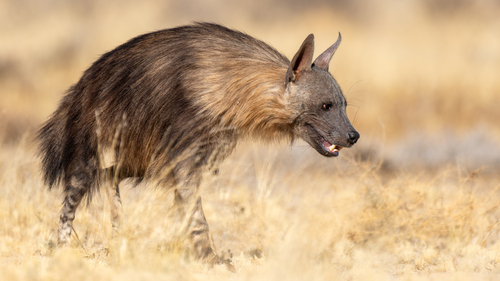
Brown hyenas (Hyaena brunnea Thunberg, 1820) can be distinguished from other hyena species by their long shaggy dark brown coat, pointed ears, and short tail. Their legs have brown and white stripes, and adult individuals have a distinct cream-colored fur ruff around their necks. Erectile hairs up to 305 mm (12.0 in) long cover the neck and back, and these hairs bristle during agonistic behavior. On average, brown hyenas have a body length of 144 cm (57 in), with a total body length range of 130–160 cm (51–63 in). Their shoulder height ranges from 70–80 cm (28–31 in), and their tail measures 25–35 cm (9.8–13.8 in) in length. Unlike the larger spotted hyena, brown hyenas do not have large size differences between the sexes, though males may be slightly larger than females. An average adult male weighs 40.2–43.7 kg (89–96 lb), while an average adult female weighs 37.7–40.2 kg (83–89 lb). Brown hyenas have powerful jaws; young individuals can crack the leg bones of springboks in five minutes, but this ability declines with age and dental wear. Compared to the closely related striped hyena, brown hyenas have larger skulls and more robust dentition, indicating a more specialized dietary adaptation. Brown hyenas live in desert areas, semi-desert, and open woodland savannah across Southern Africa. They can survive close to urban areas by scavenging, and have been recorded using the decaying infrastructure of abandoned mining towns in Namibia for shade and as den sites for mother hyenas with pups. Brown hyenas do not need readily available water sources for frequent drinking, and prefer rocky, mountainous areas because these locations provide shade. Their home ranges range in size from 233–466 km² (90–180 sq mi). In the Kalahari, 80% of a brown hyena's active time is spent at night searching for food, covering an average distance of 31.1 km (19.3 mi) per foraging trip; territories spanning 54.4 km (33.8 mi) have been recorded. They may hide excess food in shrubs or holes and recover it within 24 hours. Brown hyenas do not have a fixed mating season. Females are polyestrous and typically produce their first litter when they are two years old, and most mating occurs between May and August. Males and females from the same clan do not usually mate with each other; instead, females mate with nomadic males. Clan males do not resist this behavior, and will help females raise their cubs. Females give birth in dens hidden in remote sand dunes far from the territories of spotted hyenas and lions. The gestation period is around 3 months. Mothers generally produce one litter every 20 months. Usually only the dominant female in a clan breeds; however, if two litters are born in the same clan, the two mothers will nurse each other's cubs, though they prioritize their own. Litters usually have 1–5 cubs, which weigh 1 kg (2.2 lb) at birth. Unlike spotted hyena cubs, brown hyena cubs are born with their eyes closed, and their eyes open after eight days. Cubs are fully weaned at 12 months, and leave their birth dens after 18 months. Unlike spotted hyenas, all adult members of a brown hyena clan will carry food back to the clan's cubs. Brown hyenas are not fully weaned, and do not leave the area around their den, until they reach 14 months of age. Brown hyenas reach full size around 30 months old, and have an average lifespan of 12 to 15 years.