About Hovea pungens Benth.
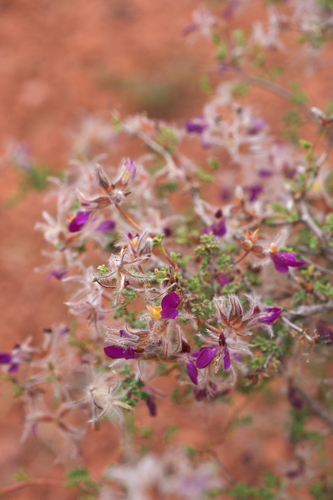
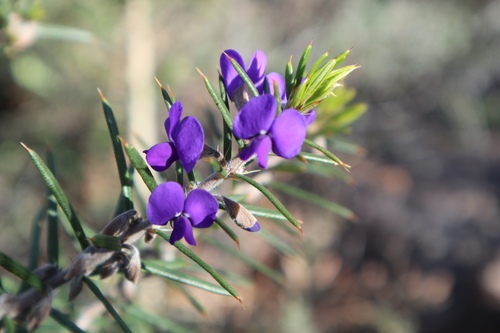
Hovea pungens Benth., also commonly called Devil's pins, and known to the Noongar people as buyenak, is an upright shrub. It typically reaches 0.2 to 1.8 metres (1 to 6 ft) in height, and may grow with a single stem or as a multi-branched plant. Its branchlets are thickly covered with a mix of straight, creased, flattened hairs that either spread out or grow upright. The plant's dark green leaves are linear, elliptic-oblong, egg-shaped, or lance-shaped, measuring 1–2.5 cm (0.39–0.98 in) long and up to 3 mm (0.12 in) wide. The upper leaf surface is smooth, the lower leaf surface is hairy, leaf margins are rolled under, petioles are 0.5 mm (0.020 in) long, and leaves end in a sharp point. Inflorescences grow in leaf axils, and are either sessile or borne on a peduncle up to 1 mm (0.039 in) long. The purple, pea-shaped flowers grow singly or in small groups of two or three, on a 0.3–0.9 cm (0.12–0.35 in) long hairy pedicel. The standard petal is 12–16.8 mm (0.47–0.66 in) long and 12–16 mm (0.47–0.63 in) wide, with a white central flare; the wing petals are 9.8–12.5 mm (0.39–0.49 in) long and 3.5–6.2 mm (0.14–0.24 in) wide; and the keel is 4.2–6.7 mm (0.17–0.26 in) long and 2.2–7 mm (0.087–0.276 in) wide. Flowering occurs from May to November, and the fruit is a smooth, oval or ellipsoid pod 0.6–0.9 mm (0.024–0.035 in) long and 0.7–0.9 mm (0.028–0.035 in) wide. This species grows in shallow soils, including granite-derived, sandy, and clay loam soils, across outcrops, coastal limestone, flats, woodland, low heath, and undulating sandplains. It is distributed across the south west coast of Western Australia, found in the Wheatbelt, Peel, South West, Great Southern and Goldfields-Esperance regions.