About Hovea linearis (Sm.) R.Br.
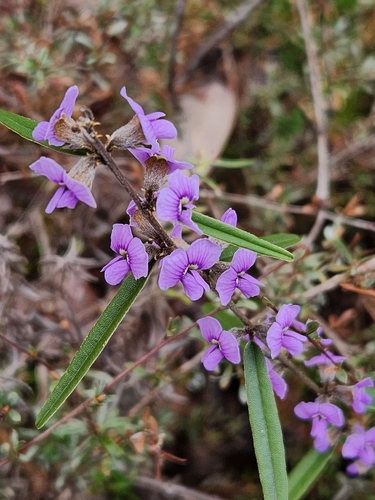
Hovea linearis (Sm.) R.Br. is an erect or trailing subshrub that can reach a maximum height of 1.2 meters (3 feet 11 inches). Its branchlets are covered in a mix of brown, silvery, and grey hairs. The plant's leaves are narrowly linear to linear in shape, measuring 30–110 mm (1.2–4.3 in) long and 1.2–6 mm (0.047–0.236 in) wide, attached to stems by a 2–3.5 mm (0.079–0.138 in) long petiole. Narrowly egg-shaped to lance-shaped stipules, 1–2 mm (0.039–0.079 in) long, grow at the base of each leaf. Leaves are held more or less erect; the upper leaf surface is hairless, while the lower surface is covered with soft hairs pressed flat against the surface. Flowers are usually arranged in pairs, with each flower growing on a 1.0–2.5 mm (0.039–0.098 in) long pedicel. Bracts and bracteoles 1.5–2.5 mm (0.059–0.098 in) long are present at the base of each flower. Sepals measure 4–6.5 mm (0.16–0.26 in) long, and the upper pair of sepals forms a "lip" 4–5 mm (0.16–0.20 in) wide. The standard petal is mauve with a yellowish-green base, and measures 7–10 mm (0.28–0.39 in) long. The flower wings are 2.5–3.5 mm (0.098–0.138 in) long. Flowering occurs between July and September, and the resulting fruit is a hairless pod that measures 7–10 mm (0.28–0.39 in) long and wide. Hovea heterophylla, a similar species to H. linearis, differs by having often spreading to pendent leaves that are usually wider, up to four flowers per leaf axil, and sepals 3.5–5 mm (0.14–0.20 in) long. Hovea linearis grows in forest and woodland habitats. It occurs mainly between Newcastle and Nowra in eastern New South Wales, and is also recorded from the Blackdown Tableland in south-eastern Queensland.