About Hovea elliptica (Sm.) DC.
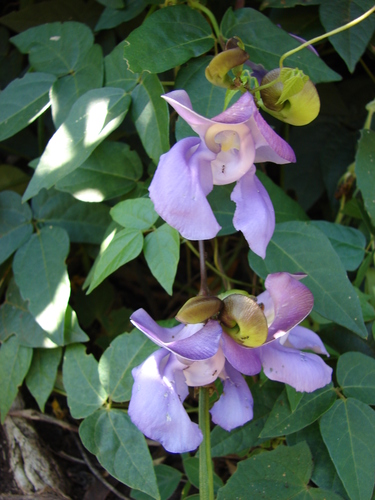
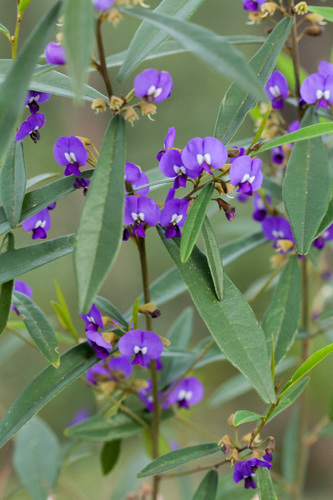
Hovea elliptica (Sm.) DC. is an erect, slender shrub or small tree that typically grows 0.4 to 3 metres (1 to 10 ft) tall. It is usually single-stemmed, and its young branches are covered in spreading, often rust-coloured hairs. Its stipules are narrow triangular, measuring around 1 millimetre (0.039 in) long. Its alternately arranged leaves have elliptical blades that reach around 7.5 centimetres (3.0 in) in length. In its native range, this species produces purple or blue pea-shaped flowers between August and December. The flowers grow in short clusters in leaf axils; each axillary inflorescence holds 1 to 7 flowers. After flowering, it forms ovoid to ellipsoid seed pods that are 0.8 to 1.2 cm (0.31 to 0.47 in) long and 0.8 to 1.3 cm (0.31 to 0.51 in) wide. Inside the pods, the olive-brown seeds are elliptic, measuring 3.8 to 5.1 mm (0.15 to 0.20 in) long and 2.8 to 3.1 mm (0.11 to 0.12 in) wide. This plant is found in the South West and Great Southern regions of Western Australia, where it grows on sand dunes, slopes, ridges, and granite outcrops. It thrives in clay, loamy, sandy, and gravelly lateritic soils, which are often rich in organic matter. It is usually a component of the understorey in jarrah, marri, and karri forest communities, and is often found growing alongside Bossiaea aquifolium subsp. laidlawiana and Hovea chorizemifolia. In horticulture, Hovea elliptica is sold commercially as seedlings or seeds. Its seeds germinate readily, though germination can be aided by scarification or pre-treatment with boiling water. This plant prefers well-drained soils and a position in open sun or partial shade. It is drought tolerant but sensitive to frost.