About Hormuzakia aggregata (Lehm.) Gusul.
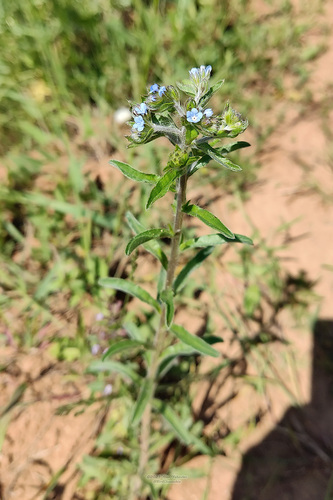
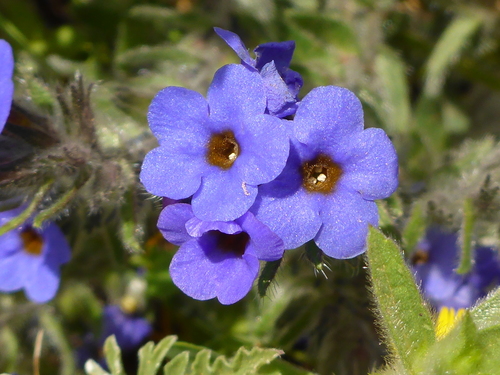
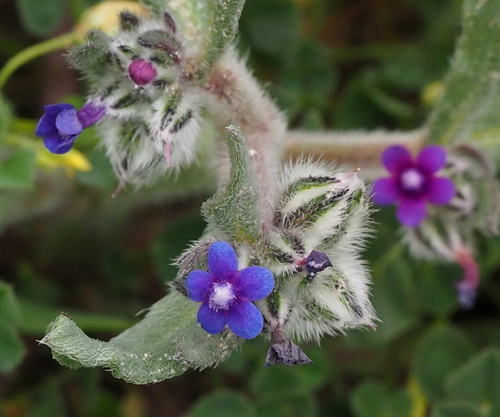
This species is the short-lived herbaceous plant Hormuzakia aggregata (Lehm.) Gusul. It produces 10 to 50 cm (3.9 to 19.7 in) ascending, hispid stems. Its entire leaves are alternate and linear-lanceolate. Flowering occurs from January to April; its small flowers range in color from dark blue to violet, and the plant produces hemispherical nutlets that measure 3 by 4 mm (0.12 by 0.16 in). It grows in Mediterranean woodlands, shrublands, shrub-steppes, and deserts, and is found in Sicily, North East Egypt, the Sinai Peninsula, Libya, Algeria, Turkey, Cyprus, Lebanon, Israel, Rhodes, Saudi Arabia, and the East Aegean Islands. The roots of Hormuzakia aggregata contain anchusin, also called alkannin or alkanet red, which is a red-brown resinoid pigment. Alkannin acts as an antioxidant and has an antimicrobial effect against Staphylococcus aureus and Staphylococcus epidermidis. This compound is also known to have wound healing, antitumor, and antithrombotic properties. Alkannin is also found in Lithospermum erythrorhizon, red-root gromwell, a plant used in Chinese herbal medicine. The dried root of this plant is a Chinese herbal medicine with various antiviral and biological activities, including inhibition of human immunodeficiency virus type 1 (HIV-1).