About Horama plumipes Drury, 1773
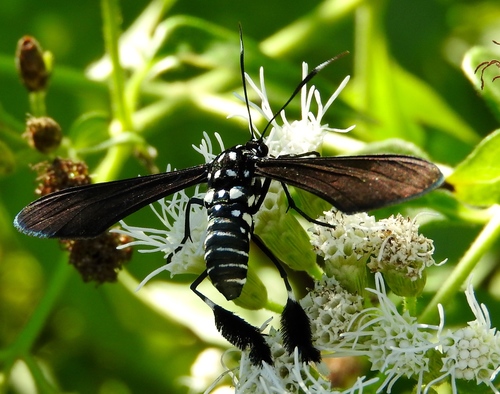
The moth Horama plumipes, first described by Drury in 1773, has the following physical characteristics. On its upperside, antennae are black with whitish tips, and are thickest at their middle segment. The head is black, with a single white spot on the front between the two antennae. The neck is black, marked with three white spots. The thorax is black, and carries several white spots. The abdomen is black, with a series of narrow white rings. The wings are dark brown and lack any markings. On its underside, the palpi are white, and the tongue is shaped in a spiral. The breast is black, with white spots along its sides. The abdomen is black: it has one broad white ring, plus several additional narrow white rings. The legs are long and black overall; the thighs are white. The hind legs bear black hair tufts arranged to resemble an arrow shaft, and the sections of the leg above and below these tufts are white. The underside of the wings matches the coloration of the upperside. This species has an approximate wingspan of 1 and 3/4 inches, which equals 45 millimeters.