About Hoplosternum littorale (Hancock, 1828)
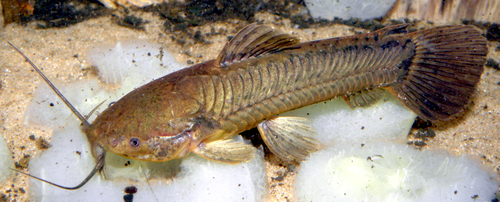
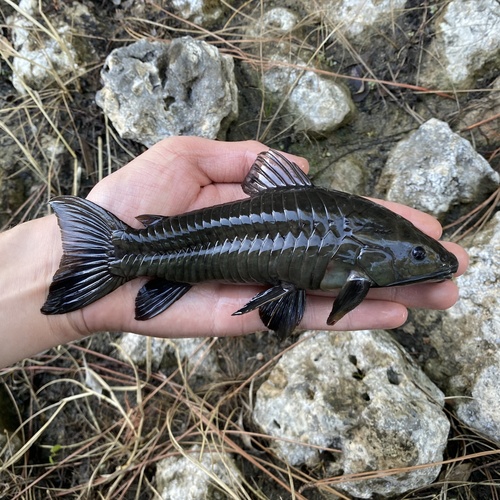
Hoplosternum littorale is an armor-plated fish species that is dorso-ventrally compressed. It reaches a maximum total length of 24.0 centimetres (9.4 in). Males grow to larger average and maximum sizes than females. During the reproductive season, males develop fat deposits in the pectoral fin and an elongated recurved pectoral spine that often takes on a reddish colour; males with this recurved pectoral spine are never found outside the reproductive period.
This species has the widest distribution of any callichthyid. It is found throughout all of South America east of the Andes and north of Buenos Aires, including the Orinoco basin, the island of Trinidad, coastal rivers of the Guianas, the Amazon River drainage, the Paraguay basin, the lower Paraná River, and coastal systems in southern Brazil, ranging from Venezuela and the Guianas to Argentina. Only one single recorded lot is known from the upper Paraná River and the São Francisco River drainage, and it has been suggested these occurrences may represent introduced populations. The species has also been introduced to Florida's Indian River Lagoon.
Most non-breeding activity of H. littorale, including feeding and locomotion, is mainly nocturnal. Its maximum reported age is 4 years. The overall diet of H. littorale consists mainly of benthic invertebrates and detritus, though its diet varies by age. Immature fish feed primarily on small aquatic crustaceans, especially Cladocera, Ostracoda, Copepoda, and Eubranchipoda. Chironomid larvae are an important food source for both juveniles and adults. The adult diet is dominated by mixed detritus, terrestrial insects, microcrustaceans, and aquatic beetles during the dry season, and mixed detritus and chironomid larvae during the wet season.
This species natively inhabits tropical standing waters or swamps. It does not occur in rainforest creeks and clearwater rivers draining the Precambrian Guyana and Brazilian Shields, which have extremely low dissolved mineral content. It is restricted to the swamps of tropical and subtropical South America and the floodplains of Andean-origin Amazonian whitewater rivers, environments characterized by low dissolved oxygen levels and strongly seasonal conditions driven mainly by rainfall fluctuations. H. littorale can breathe with both gills and through its intestines. Intestinal respiration is not present when larvae hatch, and the respiratory intestine develops throughout the juvenile period up to 32 days old. Newly hatched larvae cannot breathe air through their intestines, though they may absorb oxygen through their skin at this stage before their armor plates develop. Between 12 and 23 days of age, young fish gain the capacity to breathe air, but their respiratory intestine is not fully developed. A fully developed respiratory intestine is present between 24 and 32 days of age.
H. littorale has two types of hemoglobin: anodic and cathodic. Anodic hemoglobin has relatively low oxygen affinity and marked Bohr effects, while cathodic hemoglobin shows no significant pH-related effects. In this species, cathodic hemoglobin has a pronounced reversed Bohr effect, where oxygen affinity increases as pH decreases. This form of hemoglobin functions to safeguard oxygen transport to tissues under hypoxic and acidotic conditions.
First reproduction occurs one year after hatching. Spawning is triggered by the first rains and takes place in the warm, rainy season. As a member of the subfamily Callichthyinae, H. littorale builds a bubble nest, and this species is reported to have the most complex nest structure among callichthyines. The resulting dome-shaped nest is oxygen-rich; in the hypoxic waters of tropical swamps, the nest's main function appears to be providing oxygen to developing eggs by lifting them above the water surface while protecting them from desiccation. It may also protect the brood from predators, regulate temperature, mark the center of the male's territory, and synchronize reproductive activities. Nest-building activities usually last between 1000 and 1500 hours, and take place on clear, warm days particularly during the hottest hours, though such activities have also been reported at night. Most nests are built in newly flooded swamps, especially in open water in the peripheral area of the swamp. A minimum distance of 10 metres is maintained between nests. The nest forms the center of a territory that is vigorously defended by the male using his enlarged pectoral spines. On average, the nest has a diameter of 30 cm (12 in) and a height of 6 cm (2.36 in).
Nest building is preceded by a courtship ritual and pair formation. This process involves the male and female swimming parallel to one another, facing each other and contacting their barbels, the male stimulating the female's flanks, both fish swimming to the surface to produce the first bubbles at the nest site, and adding further bubbles to the under-construction nest. The male produces most of the nest foam. The sequence starts when the male and female rise to the surface and swim belly-up in small circles. They swallow the film from the air-water interface, then pump it out through the gills where it picks up mucus. Movement of the pelvic fins stirs water and mucus, captures air bubbles, and breaks these bubbles into foam. The female may add some bubbles to the developing nest. Pelvic fin movement differs between sexes: males move their pelvic fins side-to-side, while females open and close their pelvic fins.
The male often dives to the bottom to collect plant debris, and prefers filamentous nest materials which he knits together into the nest. The male creates an upward water current with his tail fin to lift plant materials, then uses his developed pectoral fin spines to carry the materials to the nest. He uses his mouth and pectoral fins to incorporate the plant material into the nest's foam mass. Females lack developed pectoral fin spines and do not help transport plant debris. The finished nest is dome-shaped: it has a layer of loosely interwoven plant material on top of tightly interwoven plant material, held at the water surface by a layer of foam. Eggs are laid onto this foam from below the nest.
Spawning occurs during the daytime. Evidence suggests that the female drinks sperm, and fertilization occurs after the sperm passes through her digestive tract. The male and female form a "T-position", in which the female places her mouth over the male's genital opening and collects sperm in her mouth. The female rests at the bottom for 30 to 60 seconds, then swims to the nest, turns upside down, and lays her eggs in the nest.
H. littorale is a multiple spawner. Female reproductive investment is high, as they can spawn up to 14 times over a 7-month breeding season, with each spawn producing 6,000 to 9,000 eggs. On average, two to four females spawn at the same time, leading to an average of 20,000 eggs per nest. The adhesive eggs are located in the center of the nest, under the plant debris and above the water surface, so they do not come into contact with oxygen-depleted swamp water.
The male guards the nest during incubation, which takes two to three days depending on nest temperature. He also regularly adds more foam to the nest. Nest guarding and maintenance occurs both day and night. After spawning is complete, the male attacks females that have already deposited their eggs in the nest. Despite high predation pressure on eggs and larvae, the male's guarding behavior only continues for one to two days after hatching. When attacking, the male holds his large pectoral spines erect; the attack consists of rapid propulsion towards the target followed by a sharp lateral turn, which lets the rough outer edge of the pectoral spine drag across the target and cause abrasion.