About Hoplopagrus guentherii Gill, 1862
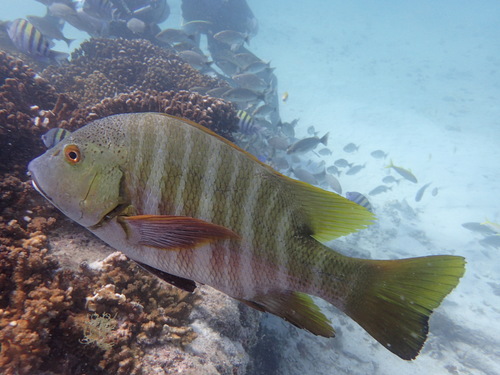
The Mexican barred snapper, Hoplopagrus guentherii, has a moderately compressed deep body, which is the deepest of all snappers, with depth measuring 44-46% of its total length. Its preoperculum is strongly incised and has a distinct knob. It has a long, anterior, tubular nostril that points downward, while the posterior nostril sits in a relatively long deep groove in front of the eye. The jaws have a band of robust molar-like teeth, and there are several similar vomerine teeth, but no teeth are present on the tongue. The dorsal fin has 10 spines and 14 soft rays, the anal fin has 3 spines and 9 soft rays, and both fins have scales on their bases. The long pectoral fins, which contain 16-17 rays, extend past the level of the anus. The overall body color is reddish-brown, with a browner head and a white chin. Six alternating broad and slender vertical white bars are present on the fish's flanks. Juveniles have closely paired bars on their flanks and a black spot on the base of the dorsal fin rays. This species reaches a maximum total length of 92 cm (36 in), with 50 cm (20 in) being a more typical length, and the maximum published weight for the species is 9.6 kg (21 lb). The Mexican barred snapper is endemic to the Eastern Pacific Ocean. Its range stretches from southern Baja California and the northern Gulf of California south to Ecuador, and it is also found around the Galapagos, Malpelo, and Cocos Islands. It lives at depths between 3 and 50 m (9.8 and 164.0 ft). Adult Mexican barred snappers inhabit rocky areas near coral reefs, and can also be found in caves. Juveniles are found in rocky tidal pools.