About Hoplocephalus stephensii Krefft, 1869
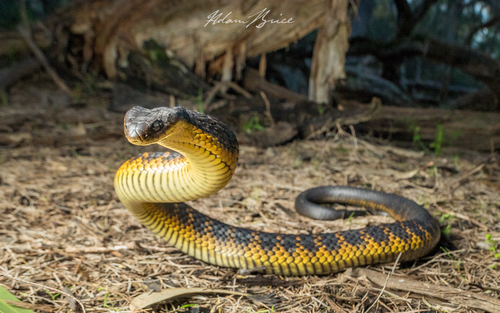
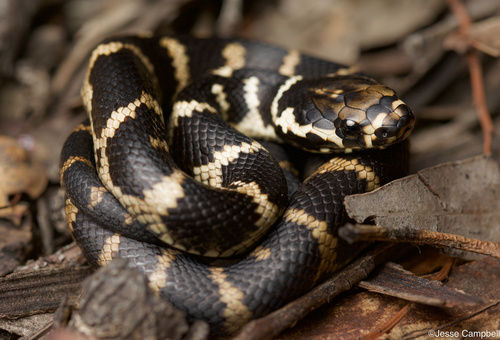
Hoplocephalus stephensii, commonly called Stephens's banded snake, grows up to 1 meter (39 inches) in total length including the tail, and some specimens have been recorded reaching over 120 cm (47 in) in total length. It is the largest species in the genus Hoplocephalus, with adult weights reaching up to 250 g (8.8 oz). On average, females of this species are larger than males. This slight sexual dimorphism is an adaptation that likely improves the reproductive capabilities of females. Stephens's banded snake has 21 rows of midbody dorsal scales as part of its anterior scalation, and 220 to 250 ventral scales. Posteriorly, its singular subcaudal scales range between 50 and 70 in number, counting from the anal plate to the tip of the tail. This species has a single (undivided) anal plate that covers its cloacal opening. Unlike ventral scales of other elapids, ventral scales of the genus Hoplocephalus have lateral notches along the caudal border of each scale. This adaptation helps the snake grip branches while climbing. Additionally, the occipital scales on the head of this snake are elongated. The dorsal side of Stephens's banded snake has alternating grey or black and dirty-white colour bands. From the back of the head to the tip of the tail, these snakes may have over 40 bands of each colour. The snake's flat, quadrangular belly is mostly dirty-white, with occasional grey splotches towards the head and tail ends. The top of this species' head is typically dark brown, and it has pale blotches or bars of patterning along its lips. Its morphological traits of a slender body and broadened arrow-shaped head allow for more agile movement in arboreal habitats, and also let it prey on a wide range of species in its ecosystem. This unique body plan reduces metabolic costs, allowing the snake to retain energy for longer periods of time. Stephens's banded snake is endemic to the east coast of Australia. Its distribution extends from its northernmost range in the Kroombit Tops of south-eastern Queensland down to the Gosford Area of New South Wales. Within this coastal range, the species is usually restricted to high-rainfall remnant forest regions that are secluded from human activity. Within its geographical range, this snake can be found at altitudes up to 950 m (3,120 ft) above sea level. Studies of this species' habitat preferences have found that it prefers to reside around 20 m (66 ft) high in the canopy of trees. H. stephensii has a broad tolerance for variations in abiotic and biotic factors, including vegetative communities and climatic changes, within the limits of its remnant forest habitats. The species favours areas with less rugged terrain, along with hollow-bearing trees, dense understory vegetation, or rocky outcrops that it can use for shelter. On average, individual male Stephens's banded snakes have a home range of 20.2 hectares (49.9 acres), while females of the species have a much smaller average home range of 5.4 hectares (13.3 acres). This difference is likely due to males leaving their typical territories to find viable mates. Studies suggest Stephens's banded snake evolved a low-energy, slow life cycle in response to limited food availability and low temperatures across its geographical range. Males of the species reach sexual maturity at three years of age, while females reach sexual maturity only after four years. In addition, individual females only become gravid every two years, and give birth to relatively small litters compared to other Australian elapids. Observations of captive Stephens's banded snakes have shown that the species engages in reproductive behaviours during the spring season. Stephens's banded snake is viviparous, and litters can range from one to nine offspring. In wild populations, the average generational length for Stephens's banded snake is eight years.