About Hookeria lucens (Hedw.) Sm.
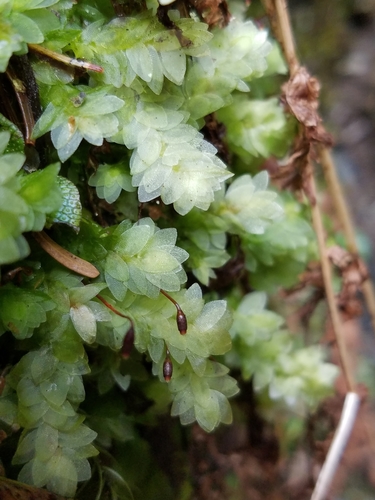
Hookeria lucens (Hedw.) Sm. is a medium to large-sized moss that grows in creeping mats or patches. When wet, it has a distinctive transparent or glass-like appearance, which comes from its large, lax cells that are visible even through a hand lens. Its stems are green, fleshy, and succulent, and usually grow 1–5 cm (0.39–1.97 in) long, occasionally reaching 7.5 cm (3.0 in). Stems branch sparsely and irregularly, and hold leaves in a flattened (complanate) arrangement along their length. The moss ranges in color from whitish to light green or pale yellow, and becomes somewhat contorted when it dries out. Leaves are arranged in a distinct pattern: leaves on the upper (dorsal) side of the stem are often broader and more symmetrical than leaves along the stem sides. Each leaf is broad and completely lacks a midrib (costa), an unusual trait among mosses. Leaves have rounded-obtuse tips and smooth, unbordered edges. A unique feature of H. lucens is the presence of scattered pairs of smaller cells throughout the leaf, where one cell in each pair is relatively smaller and square-shaped. Cells along the leaf margin are the same width as cells in the center of the leaf. When reproducing sexually, this species produces red to blackish stalks (setae) that are 1–2 cm (0.39–0.79 in) long, occasionally reaching 2.5 cm (0.98 in). These stalks hold spore-containing capsules that are oblong-cylindrical or ellipsoid in shape, and 1.5–2 mm long. A distinct characteristic of these capsules is that they become strongly contracted below the mouth when dry. Capsules mature from late fall to spring, and are protected by a short, cone-shaped cap (calyptra) that is 2–2.5 mm long. Its spores are smooth to minutely bumpy, and measure 10–17 μm (0.010–0.017 mm) in diameter. This species can also reproduce asexually via specialized filaments that grow among the rhizoids (root-like structures) at leaf tips. These filaments are unbranched, made of a single row of cells, and have a slightly rough surface. H. lucens is notable for accumulating an unusual variety of mineral deposits including bohemite, calcite, and quartz within its cells. This trait is rarely observed in mosses, and is thought to form through biomineralization, when the plant interacts with soil minerals. Hookeria lucens is predominantly a species of temperate regions, distributed across the Northern Hemisphere. In North America, it occurs along the Pacific coast and adjacent areas, specifically in Alaska, British Columbia, Washington, Oregon, California, and Idaho. Outside of North America, it grows in Europe, western Asia, and the Atlantic Islands. This moss strongly prefers humid, coastal environments, and typically grows at low to moderate elevations, generally from sea level to about 500 m (1,600 ft). It is particularly associated with the Pacific Northwest's coastal rainforest ecosystems, where it lives in several distinct habitat types. These habitats include coastal islands and their adjacent mainland areas, ravines and river systems (especially near pools), swampy lake margins, and raised bogs with peaty, waterlogged soil. It grows in wet evergreen woodlands, with a particular affinity for forests dominated by alder (Alnus), Port Orford cedar (Chamaecyparis), western hemlock (Tsuga), coast redwood (Sequoia sempervirens), and Sitka spruce. It also colonizes old, decaying logs in heathland environments, so it can grow on both soil and woody substrates. Its preference for consistently moist, often shaded environments reflects its need for high humidity and protection from direct sunlight, which are typical conditions in the Pacific Northwest's temperate rainforest ecosystems. The timing of its reproductive cycle appears to coordinate with the wet seasons of its habitat: spore-containing capsules typically mature from late fall through spring, which coincides with the rainiest period of the Pacific Northwest.

