About Homarus gammarus (Linnaeus, 1758)
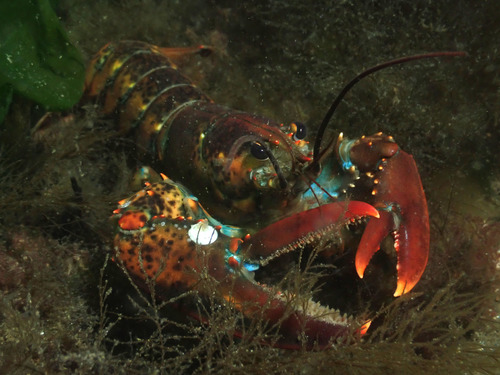
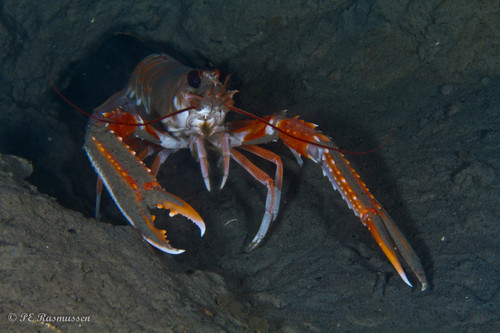
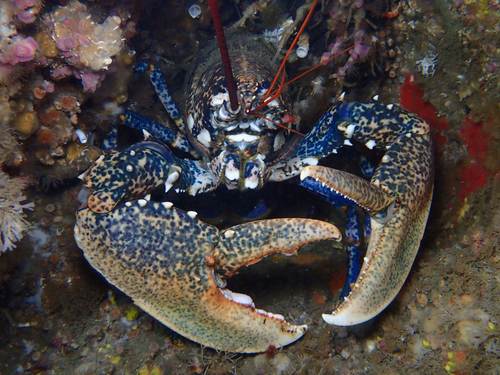
Homarus gammarus, commonly known as European lobster, is a large crustacean. Adults can reach a maximum body length of 60 centimetres (24 in) and a maximum weight of 5–6 kilograms (11–13 lb), while lobsters caught in lobster pots are typically 23–38 cm (9–15 in) long and weigh 0.7–2.2 kg (1.5–4.9 lb). Like all other crustaceans, Homarus gammarus has a hard exoskeleton that it must shed to grow, in a process called ecdysis, also known as molting. Young lobsters may molt several times per year, but larger adult lobsters only molt once every 1–2 years. The first pair of Homarus gammarus' walking legs (pereiopods) bears a large, asymmetrical pair of claws. The larger claw acts as a "crusher", and is covered in rounded nodules used to break open prey; the smaller claw acts as a "cutter", with sharp inner edges used to hold or tear prey. In most individuals, the left claw is the crusher and the right claw is the cutter. The upper surface of the exoskeleton is generally blue, with coalescing spots, while the lower surface is yellow. The bright red color people associate with cooked lobsters only appears after Homarus gammarus is cooked. This color change happens because the red pigment astaxanthin is bound to a protein complex in living lobsters; heat from cooking breaks apart this protein complex, releasing the free red astaxanthin pigment. The closest living relative of H. gammarus is the American lobster, Homarus americanus. The two species are very similar in appearance, and can be crossed artificially. Hybrids are very unlikely to occur in the wild, however, because their natural ranges do not overlap. The two species can be distinguished by several key traits: the rostrum of H. americanus has one or more spines on its underside, which H. gammarus lacks. The spines on H. americanus' claws are red or red-tipped, while the claw spines of H. gammarus are white or white-tipped. The underside of H. americanus' claw is orange or red, while the underside of H. gammarus' claw is creamy white or very pale red. Homarus gammarus is distributed across the north-eastern Atlantic Ocean, ranging from northern Norway to the Azores and Morocco; it is not found in the Baltic Sea. It also occurs across most of the Mediterranean Sea, only absent from the area east of Crete, and is found only along the south-west coast of the Black Sea. The northernmost populations of the species live in the Norwegian fjords Tysfjorden and Nordfolda, which lie inside the Arctic Circle. The species is divided into four genetically distinct populations: one widespread population, and three that have diverged due to small effective population sizes, possibly as a result of adaptation to local environments. The first diverged population is the northern Norway lobster population, which is commonly called the "midnight-sun lobster". Mediterranean Sea populations are genetically distinct from Atlantic Ocean populations. The third distinct population is located in part of the Netherlands: samples taken from the Oosterschelde are genetically different from samples collected in the North Sea or English Channel. Attempts were made to introduce H. gammarus to New Zealand, alongside another European edible species, the edible crab Cancer pagurus. Between 1904 and 1914, one million lobster larvae were released from hatcheries in Dunedin, but the species never became established in New Zealand. Female H. gammarus reach sexual maturity when their carapace reaches a length of 80–85 millimetres (3.1–3.3 in), while males reach sexual maturity at a slightly smaller carapace length. Mating usually takes place in summer, between a recently moulted (soft-shelled) female and a hard-shelled male. The female carries fertilized eggs attached to her pleopods for up to 12 months, with the duration depending on water temperature. Egg-carrying females are called "berried", and can be found year-round. The eggs hatch at night, and the larvae swim to the water surface where they drift with ocean currents and prey on zooplankton. This planktonic larval stage includes three moults and lasts between 15 and 35 days. After the third moult, juvenile lobsters take on a form much closer to the adult, and switch to a benthic (bottom-dwelling) lifestyle. Juveniles are rarely encountered in the wild, so they remain poorly studied, though researchers do know they are capable of digging extensive burrows. It is estimated that only 1 out of every 20,000 larvae survives to reach the benthic juvenile phase. When juveniles reach a carapace length of 15 mm (0.59 in), they leave their burrows and begin their adult lifestyle. Adult H. gammarus live on the continental shelf at depths between 0 and 150 metres (0–492 ft), though they are not normally found deeper than 50 m (160 ft). They prefer hard bottom substrates, such as rock or hard mud, and live in holes or crevices, emerging at night to feed. The diet of H. gammarus mostly consists of other benthic invertebrates, including crabs, molluscs, sea urchins, starfish, and polychaete worms. Three clawed lobster species — Homarus gammarus, H. americanus, and Nephrops norvegicus — are hosts to all three currently known species of the animal phylum Cycliophora; the specific Cycliophora species that lives on H. gammarus has not yet been formally described. Homarus gammarus is susceptible to the bacterial disease gaffkaemia, which is caused by the bacterium Aerococcus viridans. While the disease is commonly found in H. americanus, it has only ever been observed in captive H. gammarus, and in all recorded cases the tanks holding the H. gammarus had previously held H. americanus, so natural wild infection is not confirmed.