About Homarus americanus H.Milne Edwards, 1837
Homarus americanus, the American lobster, commonly reaches 200–610 millimeters (8–24 inches) in length and 0.45–4.08 kilograms (1–9 pounds) in weight, though it has been recorded weighing up to 20 kilograms (44 pounds), making it the heaviest crustacean in the world. Along with Sagmariasus verreauxi, it is also the longest decapod crustacean in the world. An average adult American lobster is about 230 mm (9 in) long and weighs 680 to 910 g (1.5 to 2 lb). The largest recorded American lobsters have a body (excluding claws) that is 64 cm (25 in) long. Per Guinness World Records, the heaviest recorded crustacean of all time was an American lobster caught off Nova Scotia, Canada, that weighed 20.1 kg (44.4 lb).
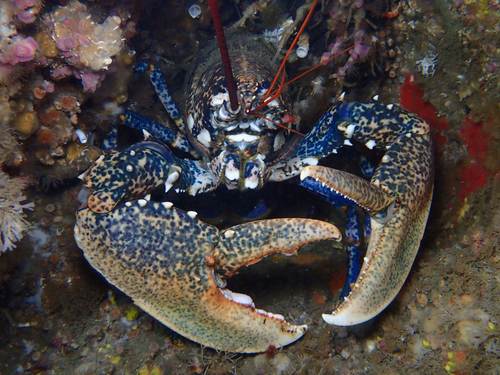
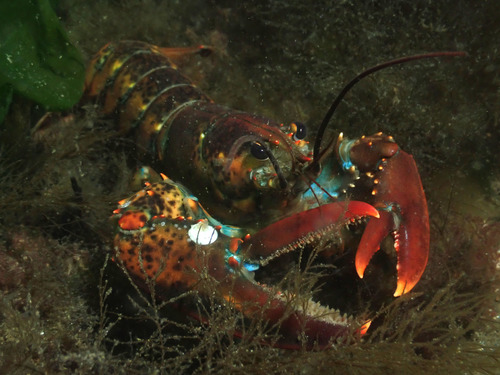
The closest relative of H. americanus is the European lobster, Homarus gammarus. The two species are very similar, and can be crossed artificially. Hybrids are very unlikely to occur in the wild because their native ranges do not overlap. The two species can be told apart by several key traits: the rostrum of H. americanus has one or more spines on its underside, which are absent in H. gammarus. The spines on the claws of H. americanus are red or red-tipped, while those of H. gammarus are white or white-tipped. The underside of H. americanus's claw is orange or red, while that of H. gammarus is creamy white or very pale red.
Homarus americanus is distributed along the Atlantic coast of North America, ranging from Labrador in the north to Cape Hatteras, North Carolina, in the south. The species is uncommon south of New Jersey, and total landings in Delaware, Maryland, Virginia and North Carolina usually make up less than 0.1% of all American lobster landings. A fossil claw identified as belonging to Homarus americanus was found at Nantucket, and dates to the Pleistocene epoch. In 2013, an American lobster was caught at the Farallon Islands off the coast of California. The species has been introduced to Norway, and may have been introduced to Iceland.
Mating only occurs shortly after a female has molted, while her new exoskeleton is still soft. The female releases a pheromone that makes males less aggressive and triggers courtship, which includes a courtship dance with claws closed. Eventually, the male inserts spermatophores (sperm packets) into the female's seminal receptacle using his first pleopods. The female can store this sperm for up to 15 months.
The female releases eggs through her oviducts; they pass the seminal receptacle and are fertilized by the stored sperm. They are then attached to the female's pleopods (swimmerets) using an adhesive, where they are cared for until they are ready to hatch. The female cleans the eggs regularly and fans them with water to keep them oxygenated. The large, telolecithal eggs resemble raspberry segments, and a female carrying eggs is called "in berry". This carrying period lasts 10–11 months, so berried females can be found at any time of year. In waters off New England, eggs are typically laid in July or August, and hatch the following May or June.
The developing embryo goes through several molts inside the egg before hatching as a metanauplius larva. When the eggs hatch, the female releases them by waving her tail in the water, setting batches of larvae free. The metanauplius of H. americanus is 8.5 mm (1⁄3 in) long, transparent, with large eyes and a long spine projecting from its head. It molts quickly, and the next three larval stages are similar in form but larger in size. These molts take 10–20 days, during which the planktonic larvae are very vulnerable to predation. Only 1 out of 1,000 larvae is estimated to survive to the juvenile stage.
To reach the fourth, post-larval stage, the larva undergoes metamorphosis. At this point, the post-larva looks much more like an adult lobster, is around 13 mm (1⁄2 in) long, and swims using its pleopods. At this stage, the lobster's claws are still relatively small, so it relies primarily on tail-flip escapes when threatened. After the next molt, the lobster sinks to the ocean floor and adopts a benthic (bottom-dwelling) lifestyle. It molts less and less frequently over time, from an initial rate of ten times per year to once every few years. After one year it is around 25–38 mm (1–1.5 in) long, and after six years it may weigh 0.45 kilograms (1 lb). By the time it reaches the minimum commercial landing size, an individual lobster will have molted 25–27 times. After reaching this size, each molt brings a 40%–50% increase in weight, and a 14% increase in carapace length. When threatened, adult lobsters generally choose to fight unless they have already lost their claws.
American lobsters thrive in cold, shallow waters that have many rocks and other shelters to hide from predators. They typically live at a depth of 4–50 m (13–164 ft), but can be found as deep as 480 m (1,570 ft) below the surface.
American lobsters are a popular food, and are commonly prepared by boiling or steaming. Hard-shell lobsters (lobsters that are several months past their last molt) can survive out of water for up to four or five days if kept refrigerated. Soft-shell lobsters (lobsters that have only recently molted) do not survive more than a few hours out of water. Lobsters are usually cooked alive, which may be illegal in some areas and which some people consider inhumane. Boiling lobsters has been banned in several jurisdictions, including Switzerland, New Zealand, and parts of Italy. Boiling has been judged to cause "extreme suffering" in lobsters, which continue to show intense brain activity for 30 to 150 seconds after being placed in boiling water. Slowly raising the water temperature may also cause pain in crustaceans over a longer period of time.
Lobster tail (the abdominal section) is sometimes served with beef in the dish surf and turf. Lobsters have a greenish or brownish organ called the tomalley, which functions like the human liver and pancreas to filter toxins from the body. Some diners consider tomalley a delicacy, but others avoid it because they see it as a toxin source, dislike eating innards, or are put off by its grainy paste texture and greenish appearance. A set of nutcrackers and a long, thin tool for pulling meat from hard-to-reach areas are considered basic tools for eating lobster, though more experienced diners can eat it with their bare hands or a simple tool such as a fork, knife or rock. Eating lobster can be messy, and most restaurants provide a lobster bib. Most lobster meat is found in the large claws and tail, and stays warm for quite a while after being served. There is also some meat in the legs and the arms that connect the large claws to the body. A small amount of additional meat is found just below the carapace around the thorax and in the smaller legs.