About Homalodisca vitripennis (Germar, 1821)
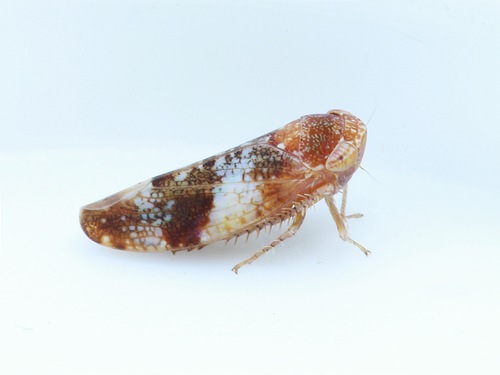
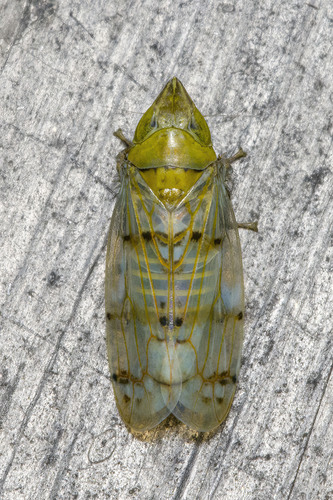
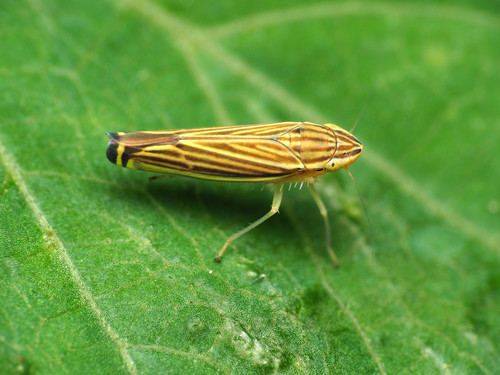
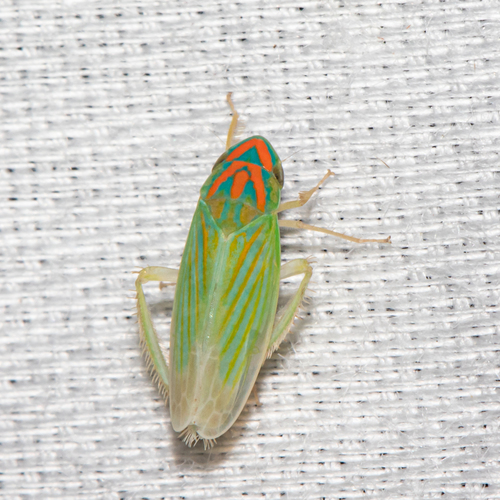
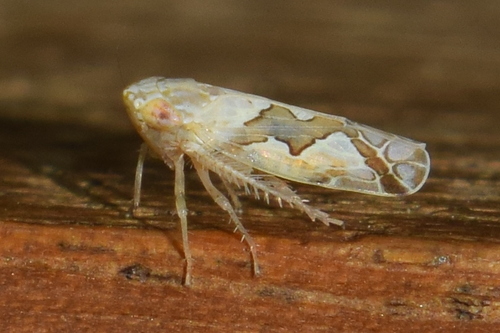
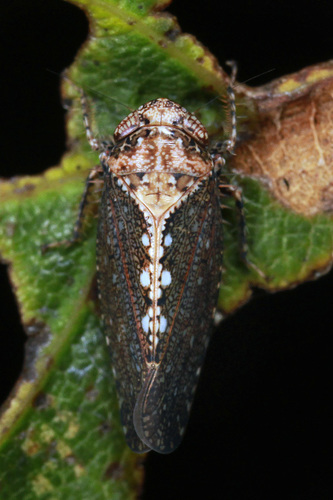
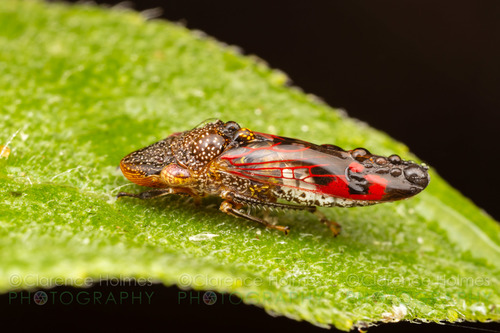
Adults of this sharpshooter species are approximately 12 millimeters (0.5 inches) long. Their upper body is dark brown to black, with a black-and-yellow underside, yellow eyes, and ivory or yellowish speckled spots on the upper head and back. Their wings are transparent with reddish veins. They have piercing-sucking mouthparts, and rows of fine spines run along their hind legs. They can eject up to 300 times their own body weight in liquid waste per day, using an energy-saving mechanism called superpropulsion: an oscillating surface ejects liquid droplets at a speed greater than the surface itself moves. This species is native to North America, specifically northeastern Mexico, and was accidentally introduced to Southern California in the early 1990s, most likely carried on ornamental or agricultural plant stock. In the introduced region, it has become an agricultural pest that particularly impacts viticulture. Glassy-winged sharpshooters typically lay their eggs in masses on the undersides of leaves. They cover these egg masses with a dry, powdery white protective secretion called brochosomes, which is stored on their wings. After nymphs hatch, the empty egg mass leaves a brown mark on the leaf surface. Nymphs feed within the vascular system of small stems on the plant where the eggs were laid. After going through several molts, nymphs develop into adult glassy-winged sharpshooters. This species feeds on a very wide variety of host plants; scientists estimate the total number of host species exceeds 70. Common host plants include grapes, citrus trees, almonds, stone fruit, and oleanders. Because they can use such a large number of plants as hosts, glassy-winged sharpshooter populations can thrive in both agricultural and urban areas. They feed by inserting their needle-like mouthparts into a plant's xylem tissue. While feeding, they excrete small droplets of filtered xylem fluid waste from their anus. This waste is mostly water with trace dissolved solutes, particularly carbohydrates, and the frequent excretion is commonly called "leafhopper rain." These droplets leave behind messy residue after the water evaporates, which gives plants and fruit a pale, whitewashed appearance. Their feeding strategy, combined with their wide host range and frequent feeding, makes glassy-winged sharpshooters effective vectors for the plant-pathogenic bacterium Xylella fastidiosa. After a sharpshooter feeds on an already infected plant, X. fastidiosa colonizes the insect's mouthparts by forming a biofilm. The bacterium is then transmitted to new plants when the sharpshooter feeds on other plants. Plants that are not negatively affected by diseases caused by X. fastidiosa can act as reservoirs, holding the bacterium for other sharpshooters to pick up and spread to additional plants. X. fastidiosa causes a number of serious plant diseases, including phoney peach disease in the southern United States, oleander leaf scorch and Pierce's disease in California, and citrus X disease in Brazil.