About Holothuria tubulosa Gmelin, 1791
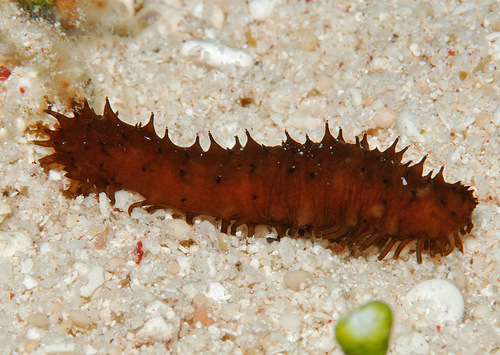
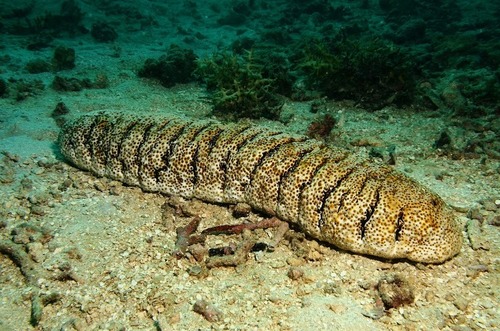
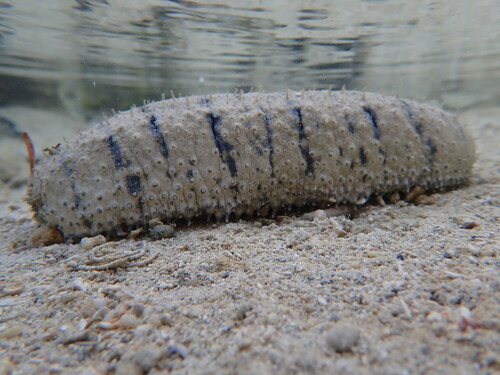
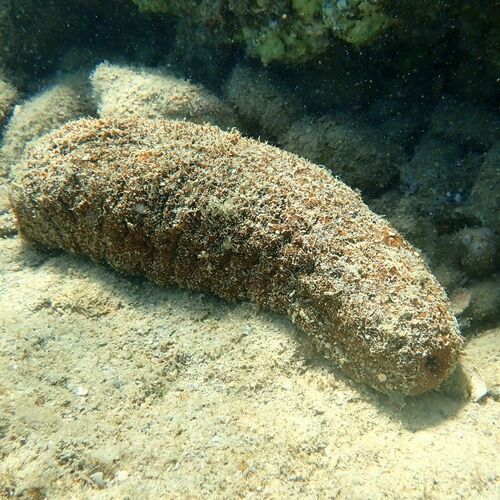
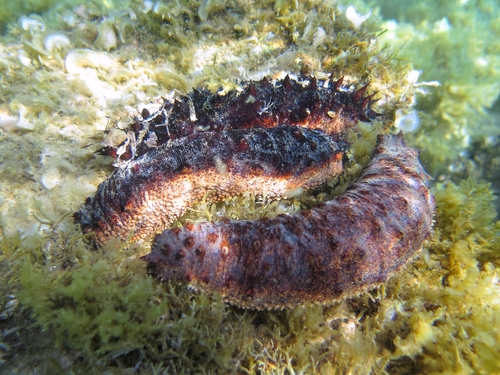
Holothuria tubulosa Gmelin, 1791 grows to a length between 20 centimetres (7.9 in) and 45 centimetres (18 in), with a diameter of 6 centimetres (2.4 in). It has a roughly cylindrical body shape with a flattened base, which bears three longitudinal rows of tube feet. Its skin is tough and leathery. Its general body colour is some shade of brown, and its surface is covered in numerous dark, conical, thorn-like projections called papillae. It often looks greyish, because it secretes a protective mucus film that can trap bits of seaweed and sediment. Around its mouth at the anterior end, it has a fringe of short, flattened tentacles, and it has an anus at the posterior end.
This species is found in temperate regions of the eastern Atlantic Ocean, ranging as far north as the Bay of Biscay, and it is abundant in the Mediterranean Sea. It occurs on sandy seabeds, among seagrass of the genus Posidonia, and on muddy rocks, down to a depth of approximately 100 metres (330 ft).
Sea cucumbers including this species are used as food in several countries, particularly Taiwan, China, Singapore and Korea. There is a commercial fishery for this species in Turkey, where a closed season in August and September is enforced to allow the animals to spawn. Holothuria tubulosa is one of the species collected by divers, who can gather 2000 to 3000 individuals in a single day. After harvesting, the sea cucumbers are sun dried, oven dried, or frozen before export. Sea cucumbers offer multiple health benefits to humans, as they contain high amounts of protein and fatty acids. Most harvesting of sea cucumbers for these uses takes place in Southeast Asian countries, where sea cucumbers became a popular resource for nutritional, biological, and pharmaceutical products in the 1980s. Holothuria tubulosa has been studied as a new source of omega-3 and omega-6 fatty acids, and for the production of bioactive peptides.