About Holothuria princeps Selenka, 1867
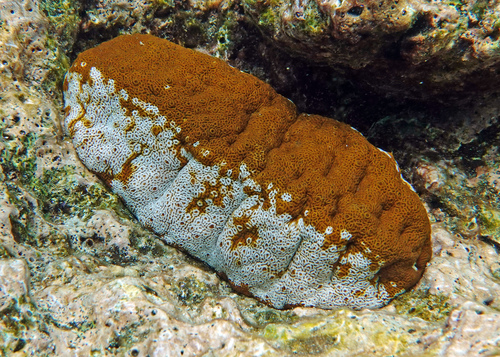
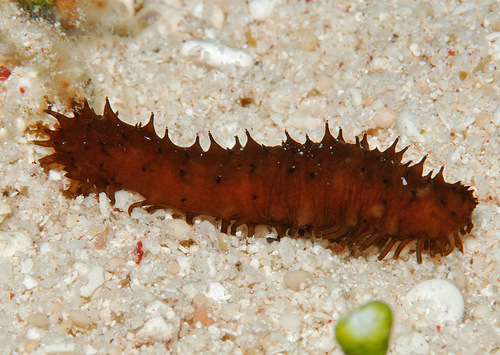
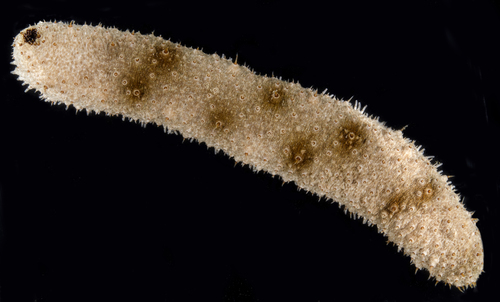
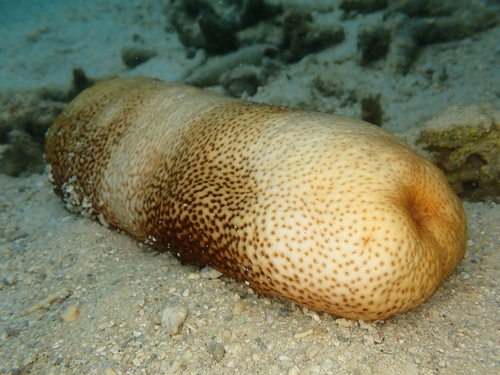
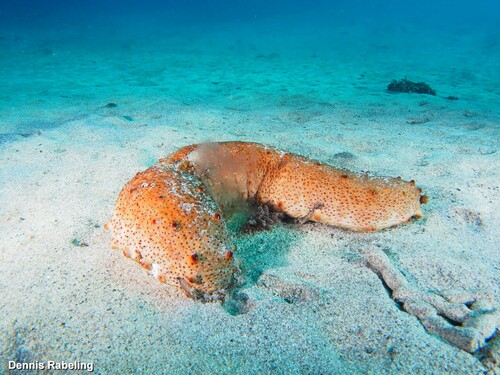
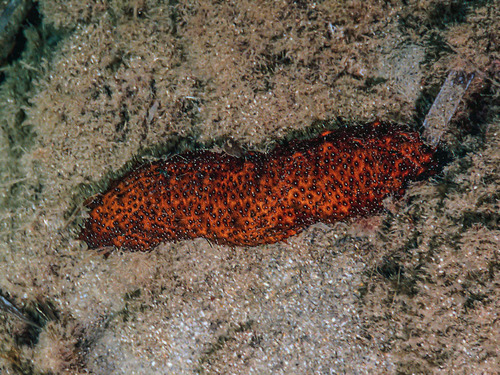
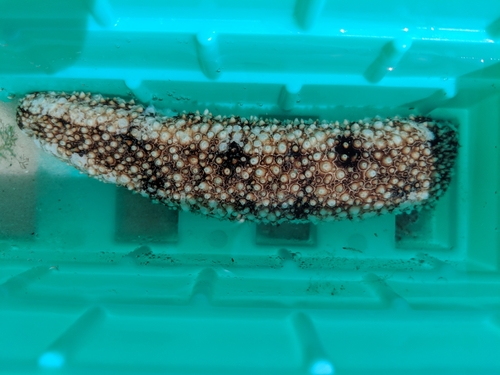
Like the roughly 1100 other sea cucumber species in the class Holothuroidea, Holothuria princeps has no immediately conspicuous features that can be easily identified as feet, eyes, mouth, anus, sexual organs, or appendages. This species can be recognized by its general characteristics: its body has the shape and size of a cucumber, and can grow up to about 30 centimeters (1 foot) in length. Its body is covered in leathery, densely warty skin, where most of the warty projections are papillae. The species has overall brown coloration that varies in hue, intensity, and pattern. Technical details that distinguish Holothuria princeps from other sea cucumber species include the following: Its body wall is relatively thick and rigid, due to a high number of embedded grain-like calcareous structures called ossicles. The papillae on its upper body surface come in a range of sizes, and tube feet with a similar appearance are scattered among these papillae. The tube feet are used for movement and adhering to the substrate. The lower surface of the body is covered with tube feet arranged in approximately 3 series of six rows, with more tube feet present on the middle portion of the lower surface. The mouth is a small, simple opening located on the lower side near the front end of the body. It is surrounded by 20 short, white, flat-topped tentacles that are only slightly larger than the nearby papillae. Many sea cucumber species discharge Cuvierian tubules through the anus as a defense mechanism, but these structures have never been observed in Holothuria princeps. This species occurs along the North Carolina coast of the United States, in the Bahamas, and extends southward through the Caribbean, including the coasts of Mexico, Colombia, and Venezuela. It is also found along the Brazilian Atlantic coast. Holothuria princeps burrows into sandy mud and shell substrates, and lives in seagrass habitats in waters as deep as 73 meters (~240 feet). Populations in Brazil have been recorded on coral reefs. As with other holothurian (sea cucumber) species, Holothuria princeps is a large-scale detritus feeder. Holothurians as a group move through and recycle up to 90% of the biomass found in the ocean's benthic zone, filling an important ecological role.