About Holothuria leucospilota (Brandt, 1835)
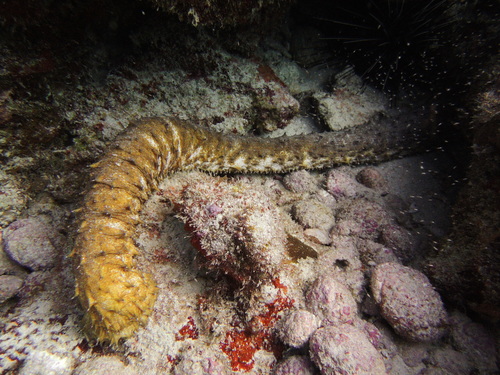
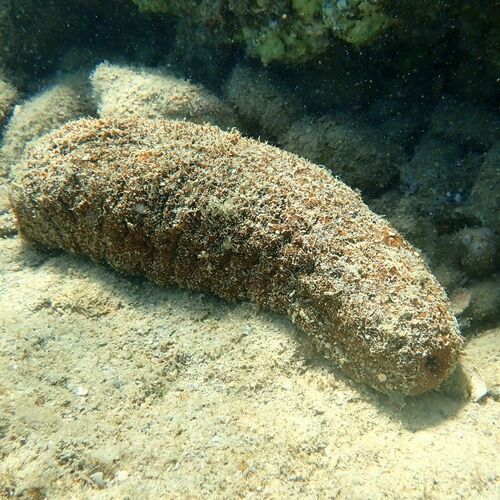
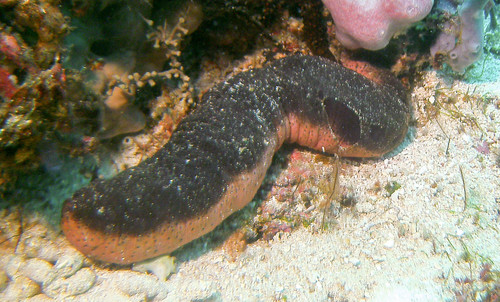
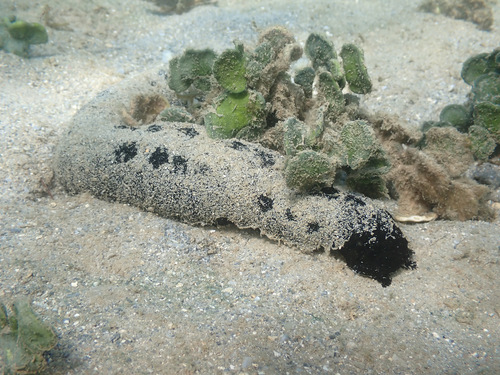
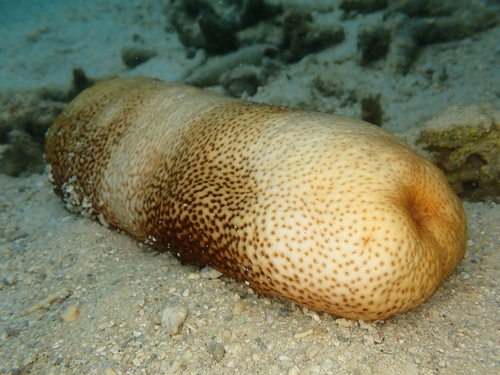
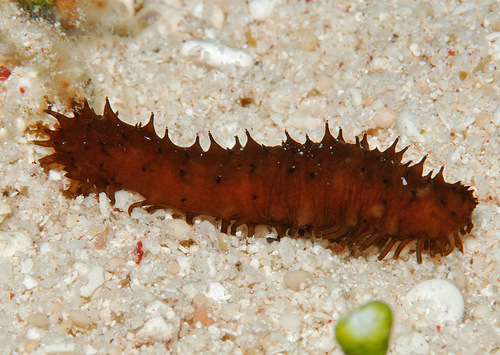
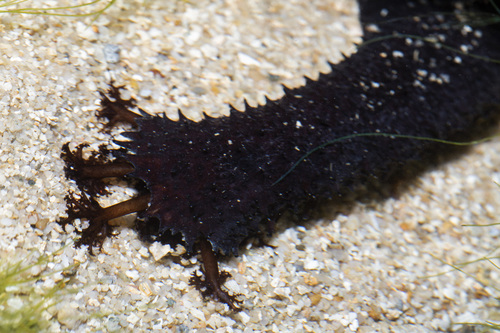
Holothuria leucospilota is a medium-sized sea cucumber. When relaxed, it reaches up to 40 centimetres (16 in) in length, and can stretch to around one metre (yard) when fully extended. Its body is roughly cylindrical, tapering toward the posterior end. At the anterior end, twenty oral tentacles with branched tips surround the mouth, which is located on the underside of the body. This sea cucumber is soft and pliable, and its body is covered with fleshy papillae. Its usual coloration is charcoal grey or reddish-black, with pale grey tube feet on its underside; however, populations off the African coast are described as bright or dark brown with white patches that grow larger toward the posterior end. Holothuria leucospilota occurs in shallow waters along the east coast of Africa and across much of the Indo-Pacific region. It is a common species on the northeast coast of Australia, where it inhabits reefs and rocky coasts, and is often found partly concealed under boulders. A study conducted near Singapore found this species to be more common in areas near boulders, corals, and seaweed clumps than on the open seabed. The study also found that H. leucospilota is relatively tolerant of changes in salinity and temperature, and continued to thrive in laboratory conditions when these parameters were altered. Under the same altered laboratory conditions, the Japanese sea cucumber Apostichopus japonicus shrank in size, eviscerated, and died within three days. In Singapore, A. japonicus is harvested as food, and is becoming increasingly rare due to overexploitation.