About Holothuria impatiens (Forsskål, 1775)
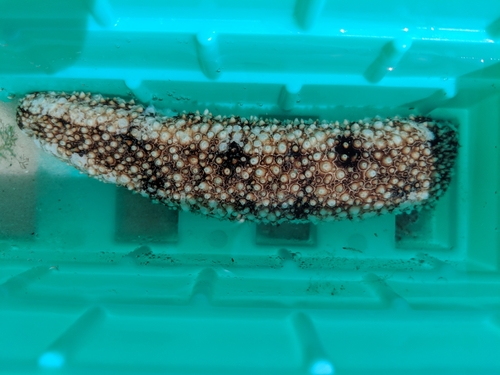
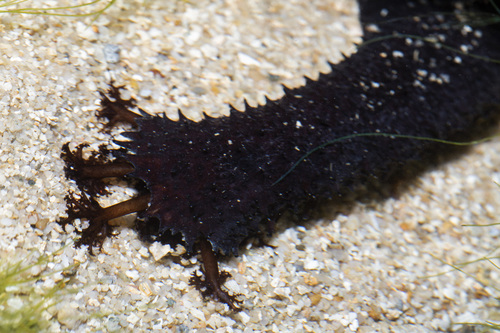
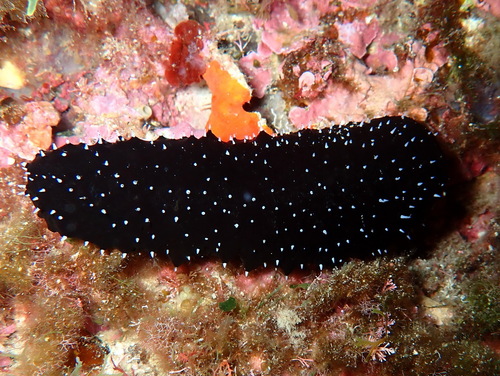
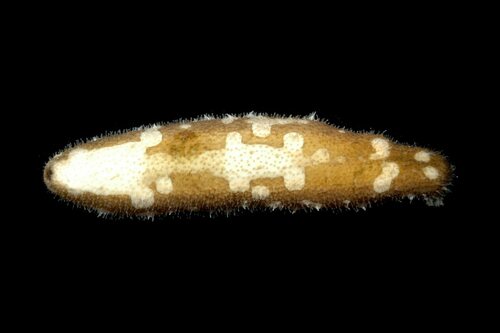
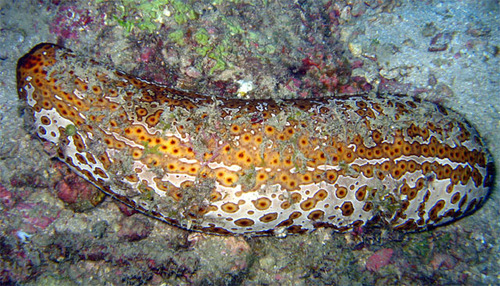
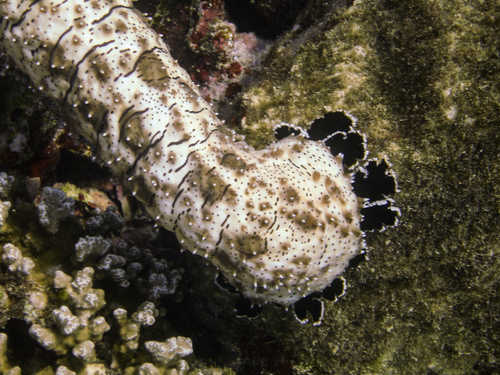
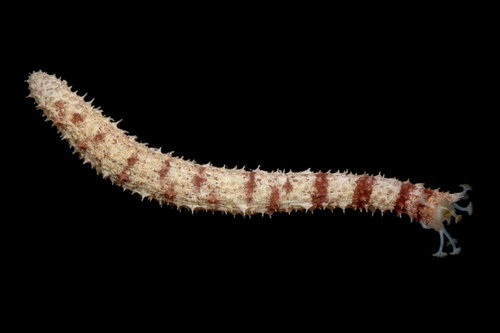
Holothuria impatiens (Forsskål, 1775) has an elongated cylindrical body, and grows to a length of roughly 15 cm (6 in). Its leathery skin is mottled brown, grey or purplish-brown, and often has alternating pale and dark colour bands. The body surface is covered in low, rounded papillae that make the skin feel rough to the touch; this texture is what distinguishes this species from the otherwise similar Holothuria hilla. Some of these papillae are surrounded by concentric brown rings. Bony ossicles shaped like smooth rounded buttons and square tables are embedded within the skin. A crown of around twenty tentacles sits at the thinner anterior end, which may be darker in colour than the posterior end. This species has a wide distribution range, including the tropical Indo-Pacific, tropical western Atlantic Ocean, Caribbean Sea, Gulf of Mexico, Mediterranean Sea, and the coasts of France. It typically lives on reef flats, in lagoons, or in open areas, most commonly underneath rocks or coral rubble, at depths ranging from about 2 m (7 ft) down to 40 m (100 ft). Holothuria impatiens may get its common name from its habit of readily expelling sticky cuvierian tubules (enlargements of the respiratory tree that float freely in the body cavity) when handled; this defensive behaviour distracts potential predators. This sea cucumber is nocturnal, very cryptic, and prefers to live in small crevices. When it finds a suitable crack, it relaxes its longitudinal muscles to work its way inside, then stiffens its collagen fibres to secure itself in place. When feeding, it only emerges halfway from the crevice. It is a deposit feeder, sifting through sediment with its feeding tentacles and ingesting the dead biological material it finds, such as fragments of seaweed. On Australia's Great Barrier Reef, reproduction occurs once annually, in late spring or early summer. Females produce a small number of large eggs. While some related sea cucumber species can also reproduce asexually via transverse fission, this behaviour has never been observed in H. impatiens.