About Holothuria hilla Lesson, 1830
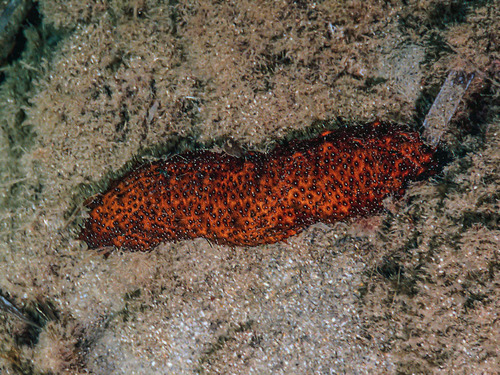
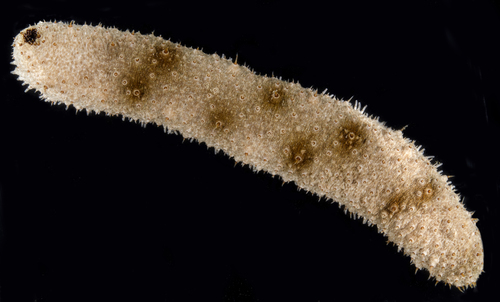
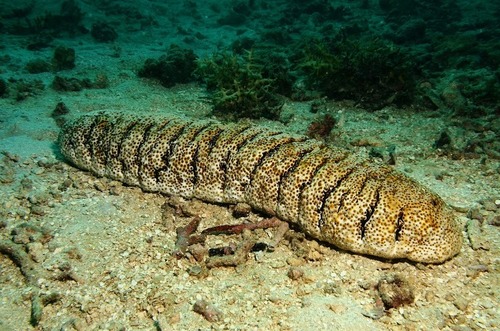
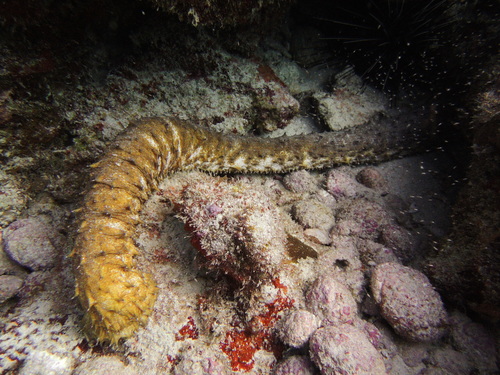
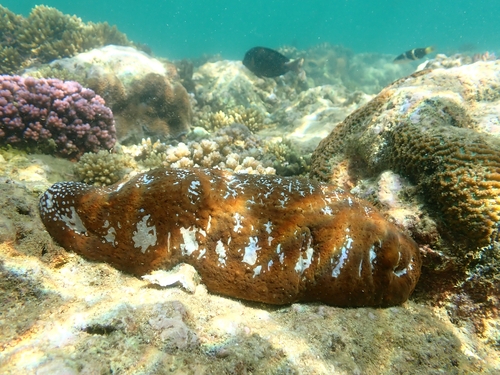
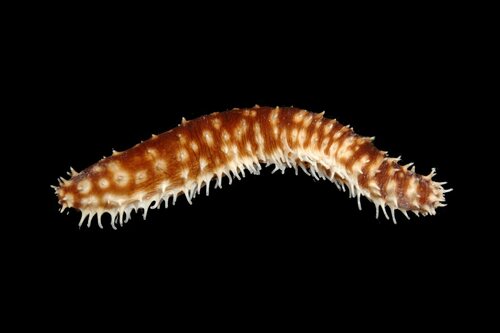
Holothuria hilla is a cylindrical sea cucumber that tapers slightly at the posterior end. Mature individuals grow to around 40 cm (16 in) in length and 5 cm (2 in) in diameter. Its outer body covering (integument) is thin, soft, and wrinkled. The dorsal (upper) surface of the body is covered in longitudinal rows of tube feet modified into thorn-like conical papillae with broad bases, and these papillae are sometimes paired. The papillae are creamy-white, which contrasts against the skin's pinkish, golden, or brown background color. The ventral (lower) surface shares a similar background color, but its papillae are arranged in four or five rows, longer, and yellowish in color. The mouth is located on the underside of the body and is surrounded by a ring of twenty yellowish peltate tentacles. This species has Cuvierian tubules, but unlike some other sea cucumber species, it does not expel these structures for defense. This species occurs in the Red Sea, Persian Gulf, and tropical west and central Indo-Pacific oceans, ranging as far east as Hawaii and even reaching Panama. It is most commonly found at depths shallower than 30 m (100 ft), though it can occasionally be found as deep as 200 m (660 ft). It inhabits sandy, rocky, and coral substrates in lagoons, seagrass meadows, and flat seabed areas. Holothuria hilla is a detritivore: it uses its oral tentacles to rake sand into its mouth, extracts and digests bacteria, animal particles, and plant particles from the sand, then expels the processed sand through its anus. This feeding behavior churns over substantial areas of the seabed. This species can reproduce either sexually or asexually. Sexual reproduction happens when males and females release their gametes into the open water column, while asexual reproduction occurs through fission. Sexual reproduction most often takes place during hotter times of year, and asexual reproduction occurs when temperatures are cooler. In Réunion, where this species is rare, only asexual reproduction via fission has been observed. When undergoing fission, the sea cucumber stops feeding and hides while splitting. The missing body parts then regenerate, and the new regenerated tissue is often paler in color than the original body tissue.