About Holothuria grisea Selenka, 1867
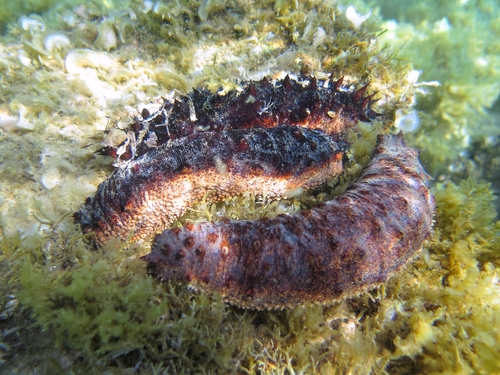
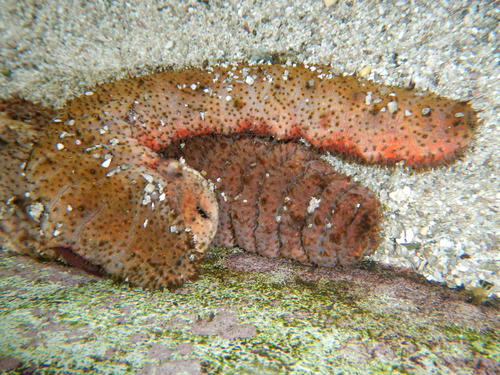
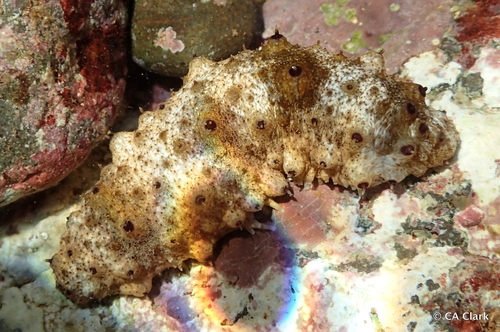
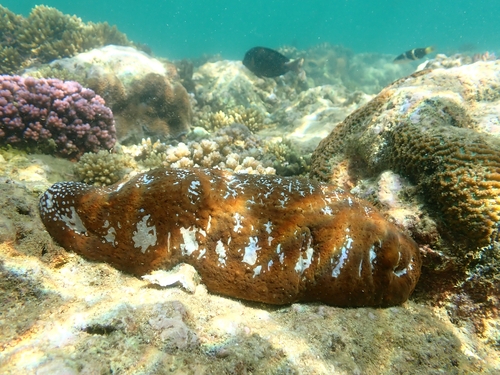
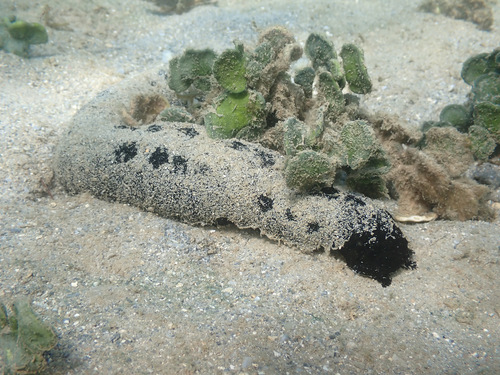
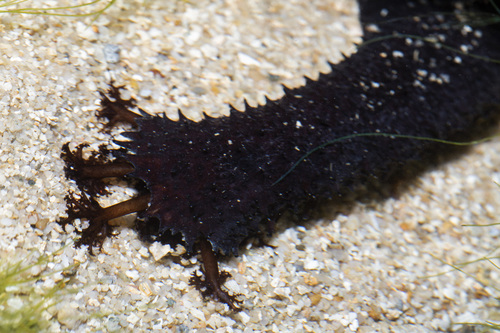
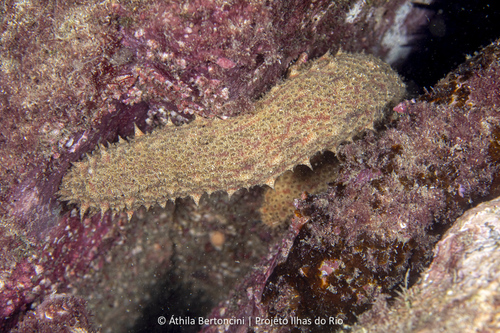
Anatomy and morphology: Like all echinoderms, the gray sea cucumber (Holothuria grisea) has pentaradial symmetry. Its body is mostly cylindrical with a flattened ventral side. It can reach a maximum length of 30 cm, but the more common average size is around 14 cm. Contrary to what its common name suggests, its coloration is variable and it is generally not gray. Its base color ranges from red to orange to yellow, marked with brown mottling that acts as camouflage in the reefs it inhabits. Its dorsal papillae are generally white, transitioning to yellow toward their tips, and both its tentacles and ventral tube feet are also yellow. Tube feet are the hydraulic structures echinoderms use for movement. There are visible morphological differences between juveniles and adults: adults have six rows of papillae on the dorsal surface, while juveniles only have four. Each papilla holds 5–10 tube feet, and the mouth is surrounded by 20–25 branched tentacles. As a bottom feeder, the mouth faces downward. The body is covered in ossicles—calcified structures that form a partial skeleton that gives echinoderms structure and rigidity—and internal plates also serve this same structural function. H. grisea is an osmoconformer, meaning its internal salt content (osmotic pressure) matches that of the surrounding water. Habitat and distribution: Holothuria grisea is a coastal tropical species found in the Atlantic Ocean. It generally prefers shallow waters, and can be found in sand flats, seagrass beds, and reefs. Geographically, it occurs in Florida, the Caribbean islands, Central America, Brazil, and West Africa. Because it is an osmoconformer, salinity has a major impact on its distribution. Life history and reproduction: Like most echinoderms, the gray sea cucumber is gonochoristic, meaning it has two distinct separate sexes. Fertilization occurs externally via broadcast spawning, where eggs and sperm are released into the water column to meet. Spawning is seasonal rather than random, and can be triggered by changes in light availability, temperature, salinity, moon phase, food availability, and other factors, occurring in a regular cyclical pattern. Gray sea cucumbers aggregate to spawn in June and July, during the rainy season when phytoplankton growth is high. Aggregation improves broadcast spawning success by concentrating gametes in the same area, and timing spawning with phytoplankton growth provides newly hatched larvae with an abundant food source. Spawning is also timed to coincide with high tides and low light conditions. When newly hatched, gray sea cucumber larvae are meroplanktonic auricularia that are non-feeding and sustain themselves from a yolk sac. The next planktonic stage is doliolaria, defined by the presence of 5 ciliary bands. After the doliolaria stage, individuals develop into juveniles, which have 4 rows of papillae, before maturing into adults with 6 rows of papillae. The species reaches sexual maturity at around 2 years of age, and has an average lifespan of 5–10 years. Ecology and diet: The gray sea cucumber is a deposit feeder, meaning it sifts through sediment to sort out organic material including organic waste, algae, small aquatic invertebrates, and other detritus that sinks to the seabed. It plays an important role in the ecosystem by recycling organic matter and returning it to the food web. Sea cucumber eggs and larvae are an important food source for many other species, including juvenile fish and other small organisms. Adults are preyed on by larger predators such as starfish, crabs, fish, and sea turtles, which transfers energy from detritus up the food web to higher trophic levels. Both adult and juvenile gray sea cucumbers often bury into sand, and act as bioremediators as they sift through sediment while feeding. Their feeding activity causes high levels of bioturbation, which is beneficial to marine ecosystems. They release inorganic phosphorus and nitrogen, which are essential nutrients for benthic organisms. H. grisea also acts as a host for many parasites and symbiotic species, increasing overall ecosystem biodiversity. The species' feeding behavior and excretions help buffer the marine environment against ocean acidification.