About Holothuria fuscocinerea Jaeger, 1833
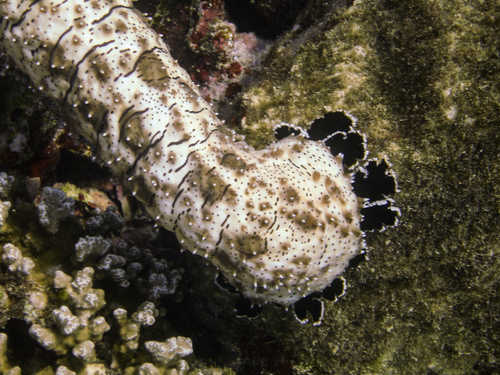
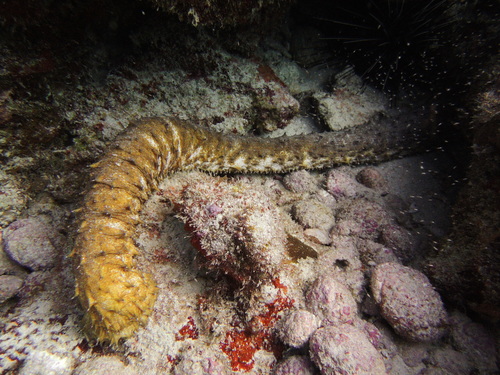
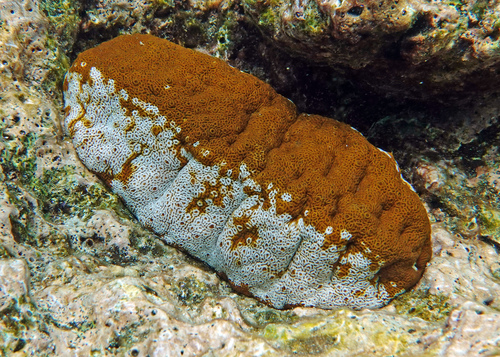
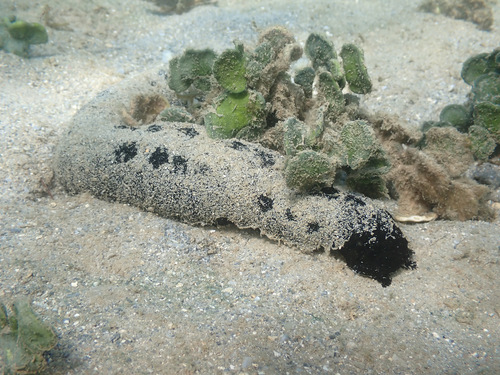
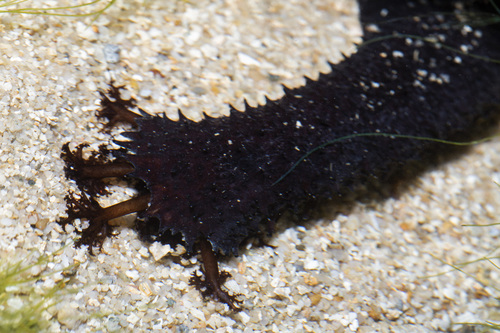
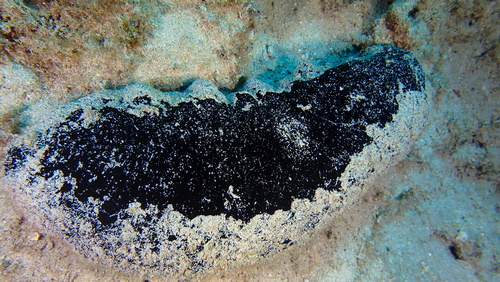
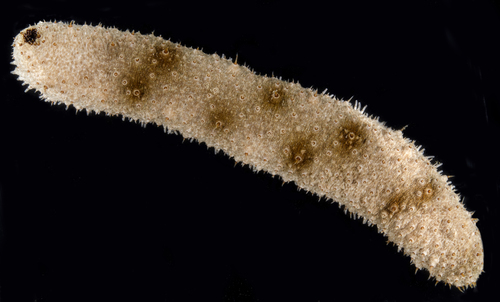
This species of sea cucumber, Holothuria fuscocinerea Jaeger, 1833, has an oval cylindrical body that is somewhat flattened on its underside and rounded at both ends. It can grow up to 70 centimetres (28 in) long, with 50 centimetres (20 in) being a more typical adult size. Adult individuals weigh between 3 and 5.5 kilograms (7 and 12 lb). Its mouth is located on the underside at the front of the body, and is surrounded by twenty short, brown, branched feeding tentacles. The anus is dark brown or black, lacks anal teeth, and is surrounded by five papillae with white tips. This species possesses Cuvierian tubules. Its skin is soft, thick, and wrinkled, and often has sand adhering to its surface. Its colouration varies across individuals; the upperside is usually greyish or brownish, while the underside is a dirty white. A series of dark bars often appears within the transverse wrinkles of the skin. H. fuscocinerea has a widespread distribution across the Indian and Pacific Oceans. Its range extends from East Africa and the Red Sea to southern Japan, northern Australia, and Central America. It typically inhabits coral rubble, soft sediments, and areas among seagrasses. It is usually found at depths of less than 10 m (33 ft), but can occur as deep as 40 m (130 ft). H. fuscocinerea is a detritivore that feeds at night. It sifts through sediment using its feeding tentacles, swallows the sediment, extracts the contained bacteria and organic material, and allows sand to pass through its gut. Breeding occurs during the hot season. This species has separate sexes; individuals climb to an elevated location before releasing their gametes into the water column. Females produce an average of around three million eggs. The larvae are pelagic and drift along with plankton. Once sufficiently developed, they settle on the seabed and undergo metamorphosis into juvenile sea cucumbers. Like other sea cucumbers, the tissues of H. fuscocinerea contain saponins. These compounds are distasteful and toxic to fish, and cause haemolysis of red blood cells, which can be fatal. The skin of this species periodically flakes off in small shreds, and fish have been observed nibbling these shreds. This desquamation process may be a method for the sea cucumber to eliminate metabolic waste from its body.