About Holothuria forskali Delle Chiaje, 1823
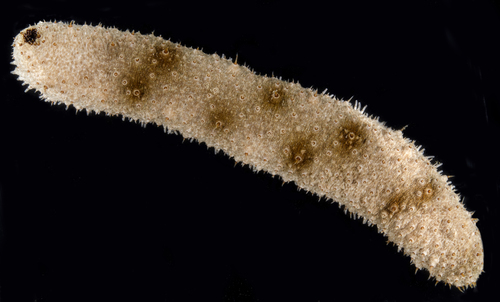
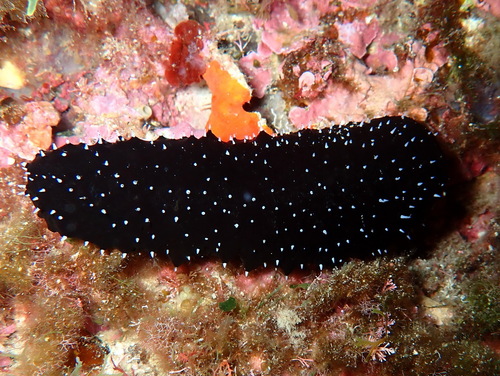
This species of sea cucumber, Holothuria forskali, has a cylindrical body that can reach up to 30 centimetres in length. Its body is most commonly deep brown or black, though it sometimes has underlying yellowish mottling, particularly on its underside. The skin is soft but also coarse and tough, and it is covered in fleshy papillae that are often tipped with white. These papillae are thought to be sensory organs, sensitive to touch and possibly to chemicals dissolved in water. On the underside, there are three rows of tube feet that the sea cucumber uses for walking and climbing, while the upper surface has two rows of rudimentary suckers. The anterior (front) end has a cluster of twenty short, yellowish, retractable tentacles that surround the mouth. At the posterior (rear) end, inside the body cavity, there is a bundle of structures called Cuvierian tubules, or cotton glands. These can be ejected as a tangled mass of sticky white threads to confuse or trap predators. Holothuria forskali, also called the black sea cucumber, is distributed around the Atlantic coasts of northwest Europe, the Canary Islands, the Azores, and throughout the Mediterranean Sea. It lives on boulders and rocks, especially vertical rock surfaces, ranging from the intertidal zone down to around 50 metres deep. The parasitic copepod Asterocheres boecki acts as an endoparasite of this sea cucumber. Twenty-six different saponins (triterpene glycosides) have been found in the Cuvierian tubules of Holothuria forskali, and twelve have been found in its body wall. When the sea cucumber is stressed, such as when a predator is nearby, these saponins are released into the surrounding water. Researchers think that while these saponins are not abundant enough to harm a potential predator, they may act as a warning that the sea cucumber is unpalatable.