About Holothuria atra Jaeger, 1833
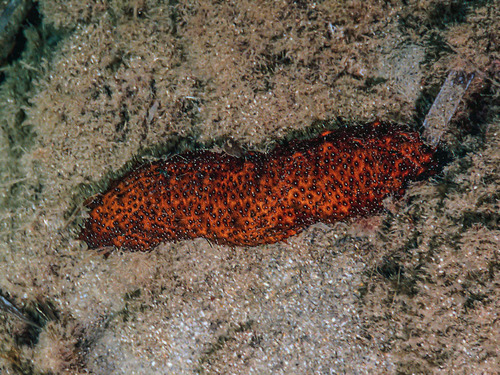
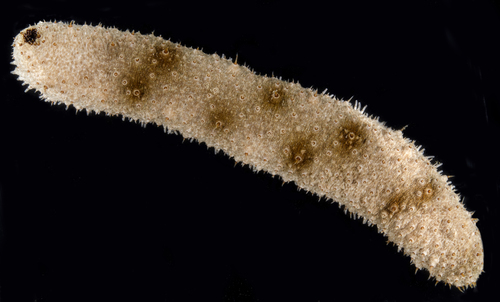
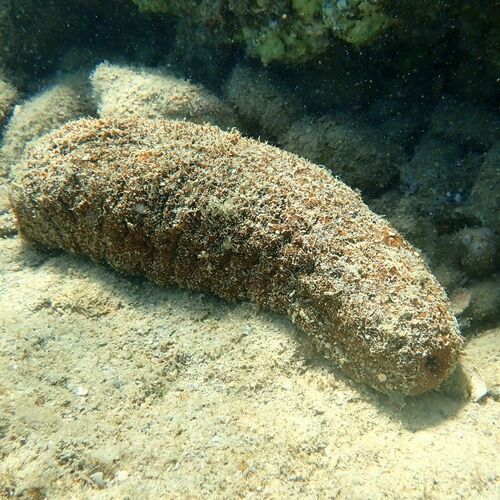
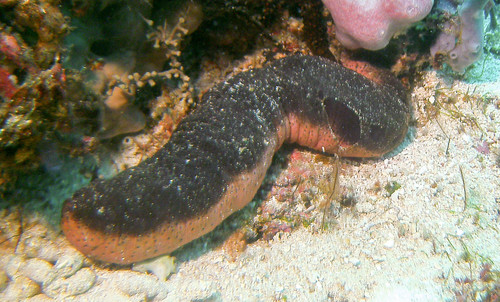
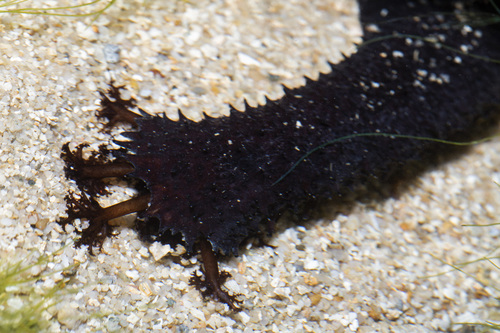
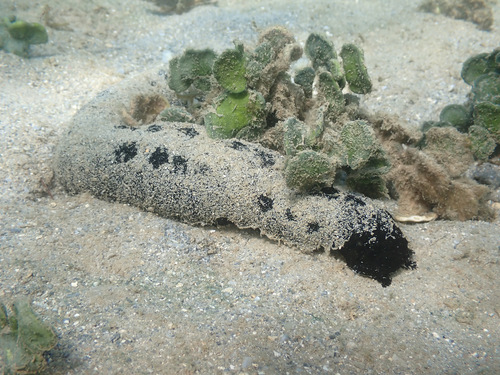
Holothuria atra Jaeger, 1833 is a species of sea cucumber. It can reach a maximum length of 60 centimetres (24 in), though 20 centimetres (7.9 in) is a more typical size. It has smooth, pliable, completely black skin, which often has sand stuck to it, especially in smaller individuals. Its mouth is located on the underside at one end, and is surrounded by a fringe of 20 black, branched tentacles. The anus is positioned at the opposite end. This species is native to the tropical Indo-Pacific region, with a range extending from the Red Sea and East Africa to Australia. It lives on the seabed in shallow water, occurring on reefs, sand flats, and in seagrass meadows at depths of up to 20 metres (66 ft). While its black colouring makes it naturally conspicuous, it is very often camouflaged by its coating of sand. This sand covering may also help keep the sea cucumber cool by shielding it from the sun's rays. H. atra prefers reef flats that are not fully exposed to waves but have well-aerated water, as well as shallow areas beside rock slabs where cool water flows out from under the rock when the tide recedes. In these habitats, it is commonly found in pools above the low tide mark that are warmed by the sun during the day. This species tolerates high water temperatures well; individuals remained healthy and continued feeding even when water temperatures reached 39 °C. Like many echinoderms, H. atra performs sediment bioturbation, a process that is important for maintaining healthy coral reefs. It is often found associated with Gastrolepidia clavigera, a black polychaete worm that crawls across the sea cucumber's skin. H. atra has few natural predators. A small crab, Lissocarcinus orbicularis, is known to live on this sea cucumber in a commensal relationship. In the Pacific Islands, H. atra is collected by diving or wading at low tide for human consumption, but it has a low commercial value. On Guam, the toxic red fluid that this species releases is used to flush octopuses out of their hiding holes. Compounds with potential biomedical relevance, including lectin, steroidal sapogenins, and triterpene glycoside, have been found in H. atra.