About Hologymnosus doliatus (Lacepède, 1801)
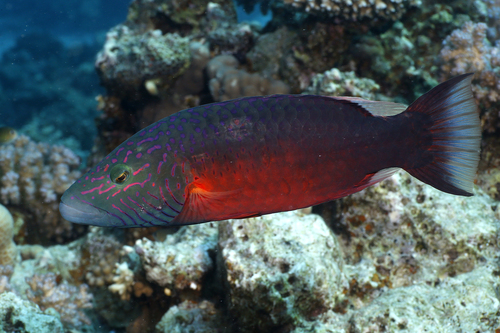
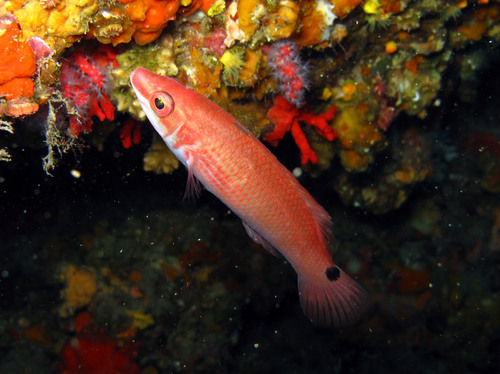
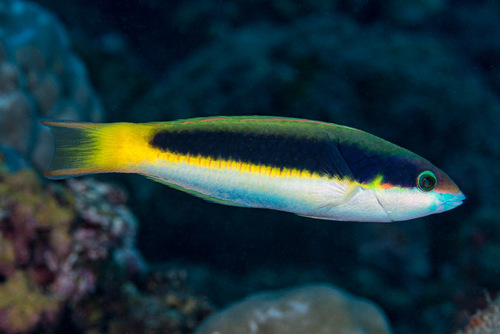
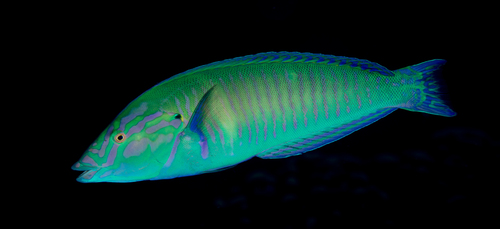
Hologymnosus doliatus has a long, slender body covered in small scales, and its head lacks scales. Males of this species range in colour from bluish-green to pale reddish, marked with lavender bars. They have a pale band just behind the pectoral fin, and orange lines across their head. Females are bluish, greenish, or greyish, and display 20 to 23 orange bars along their flanks, with a bluish-black spot on the posterior edge of the gill cover. Juveniles are whitish, marked with three thin orange-red stripes. The dorsal fin of Hologymnosus doliatus has 9 spines and 12 soft rays, while the anal fin has 3 spines and 12 soft rays. This species can grow up to 50 centimetres, or 20 inches, in total length.
Hologymnosus doliatus is distributed across the Indian and Pacific Oceans, ranging from East Africa and South Africa eastward to Samoa and the Line Islands, northward to Japan, and southward to the Great Barrier Reef, Lord Howe Island, and New Caledonia. In Western Australia, its range extends as far south as Ningaloo Reef.
This species lives on seaward reefs that feature a mix of sand, rubble, and coral, at depths down to at least 30 metres, or 98 feet. Juveniles live in groups close to the seabed, while adults swim well above the bottom. Females typically occur in small groups, while males are solitary and territorial, guarding a large section of reef. This is a carnivorous species: fishes make up 50% of its diet, and it also feeds heavily on crustaceans, especially shrimps. It will additionally eat brittlestars and polychaete worms.