About Holodiscus discolor (Pursh) Maxim.
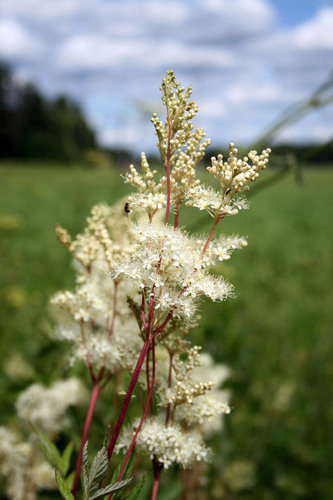
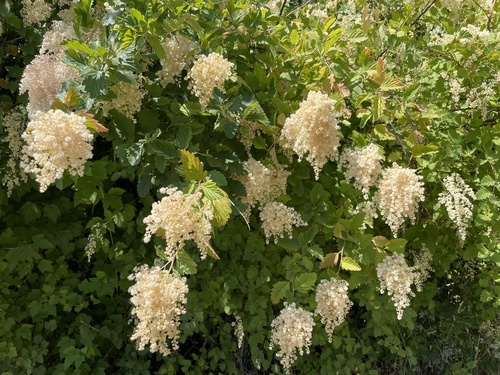
Holodiscus discolor (Pursh) Maxim. is a fast-growing deciduous shrub that typically reaches 1.2–1.5 metres (4–5 feet) in width, and grows up to 2.1 m (7 ft) tall. It has alternate, lobed small leaves that measure 5–9 centimetres (2–3+1⁄2 inches) long and 4–7 cm (1+1⁄2–3 in) broad, and turn juicy green when new. Young branches of this shrub have longitudinal ridges. Drooping, cascading clusters of white flowers grow from its branches, which gives the plant its two common names. These flowers have a faint sweet, sugary scent, and bloom from May to July. After blooming, it produces a small, hairy fruit that holds one seed; the seed is light enough to be dispersed by wind. This species is common in the Pacific Northwest, and is found throughout California in a diverse range of habitats, including California mixed evergreen forest, California oak woodlands, chaparral, Coast redwood forest, Douglas-fir forest, Yellow pine forest, Red fir forest, and Lodgepole pine forest. It is native to multiple regions of California: the High Sierra Nevada, Northern and Southern California Coast Ranges, Klamath Mountains, Santa Cruz Mountains, Western Transverse Ranges, and the San Gabriel Mountains. It occurs both in openings and as a common understory shrub in a variety of forest overstories, at elevations ranging from 300–1,300 m (980–4,270 ft). In open mountain habitat of the Sierra Nevadas, it can grow as high as 3,500 m (11,500 ft). It grows in habitats ranging from moist coastal forests to drier, cooler mountains of inland California. The plant is often found in areas prone to wildfire, and is frequently the first plant to produce new green shoots in areas recovering from burns. It is also common in chaparral communities, a fire ecology ecosystem that evolved with regular periodic burning. It may also grow in areas that have been cleared by logging. In the California black oak woodland plant community, common understory associate species include Toxicodendron diversilobum (Western poison-oak), Heteromeles arbutifolia (toyon), and Dryopteris arguta (coastal wood fern). Ecologically, Holodiscus discolor is a pollinator plant of special value to native bees and butterflies. It also acts as a larval host plant for caterpillars of Lorquin's admiral, pale tiger swallowtail, and spring azure. Historically, Indigenous peoples have used this plant for a wide range of purposes. Indigenous groups ate its seeds both raw and cooked, and boiled its leaves alongside leaves of other plants with small game animals. Many tribes used its wood and bark to craft tools and furniture. Valued for the strength of its wood, it was often used to make digging sticks, spears, arrows, bows, harpoons and nails. Like wood from many other plant species, its wood was often hardened with fire then polished using horsetail. Comox natives use oceanspray (the common name for this plant) when it is flowering as an indicator that it is the best time to dig for butter clams. For medicinal uses, the Lummi people used the flowers of this species as an antidiarrheal, and applied its leaves as a poultice. Several First Nations groups, including the Stl'atl'imx, steeped its berries in boiling water to make a treatment for diarrhea, smallpox, and chickenpox, and used it as a blood tonic.