About Holbrookia subcaudalis Axtell, 1956
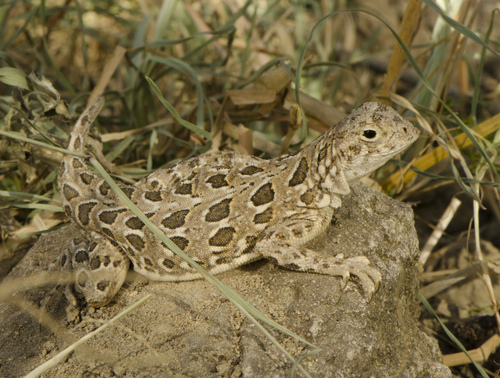
The southern spot-tailed earless lizard (Holbrookia subcaudalis Axtell, 1956) has an overall light grayish tan base color. It features two paravertebral rows of transverse dark blotches that each have light edges, with one row running down each side of the back. It also has a second lateral row of dark blotches with pale edges, and these blotches are usually not connected to the paravertebral blotches. Adult individuals reach a total length of 11.5 to 15.4 cm (4.5 to 6.1 inches). The ventral surface of the lizard's tail has round dark spots, a trait that gives the species both its common name and its scientific name. Like all other earless lizard species and subspecies, this lizard has no external ear openings. When females are gravid, their neck and trunk often turn greenish yellow. This species occurs in northern Mexico and southern Texas in the United States. Its preferred habitat is subhumid agricultural and non-agricultural flatlands, as well as very low rolling hills, with sparse vegetation including small patches of grass growing on dark clay loam soils, along with a few mesquite trees. Prickly pear cactus is not present in this preferred habitat. This species is oviparous, meaning it reproduces by laying eggs.