About Holacanthus tricolor (Bloch, 1795)
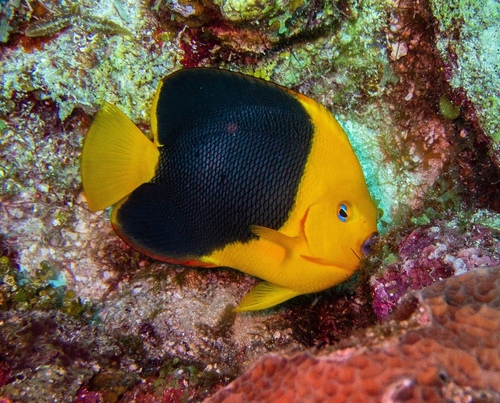
The rock beauty, Holacanthus tricolor, has a deep, oval, strongly compressed body with a short snout that ends in a small mouth lined with bristle-like teeth. A large spine sits at the angle of the preopercle, which has a serrated vertical edge. The bone between the preopercle and gill cover bears 1–4 large spines. Juvenile rock beauties have yellowish bodies and fins, with a black spot with a blue margin on the upper posterior part of the body. As the fish matures into an adult, this spot grows, eventually covering most of the body, the lower part of the dorsal fin, and the upper part of the anal fin. The head, anterior quarter of the body, and the pectoral, pelvic, and caudal fins are yellow. The mouth is purple, the front edge of the anal fin and the margin of the operculum are orange, and the upper and lower portions of the iris are vivid blue. The dorsal fin has 14 spines and 17–19 soft rays, while the anal fin contains 3 spines and 18–20 soft rays. This species reaches a maximum total length of 30 centimetres (12 in).
The rock beauty occurs in the Western Atlantic Ocean, ranging from Bermuda and the waters off Georgia and Florida southward through the Caribbean Sea, along the coasts of South America as far south as Rio de Janeiro. It is uncommon and localised in the Gulf of Mexico, where it is only found at the Flower Gardens Banks off Texas, off Veracruz, and on the Campeche Bank in Mexico.
This species lives at depths between 3 and 92 metres (10 and 300 ft), found around jetties, rocky reefs, and coral reefs; juveniles are often seen in areas of fire coral. Rock beauties feed mostly on sponges, but will also eat corals, zoantharians, bryozoans, gorgonians, tunicates, and algae. Adults are typically found in pairs that form long-term monogamous bonds. These pairs usually consist of one larger and one smaller individual, which may indicate sexual dimorphism, though there is no sexual dichromatism. When mating, the pair ascends through the water column with their abdomens held close together, releasing eggs and milt into the open water. A single female can lay between 25,000 and 75,000 eggs in one evening, and up to 10 million eggs per breeding season. The transparent eggs are pelagic, floating in the water column, and hatch after 15–20 hours. Newly hatched larvae have a large yolk sac and no functional eyes, gut, or fins. After 48 hours, the yolk sac is fully absorbed, and the larvae develop a form closer to that of typical fish. Larvae feed on plankton in the water column and grow rapidly; they settle on the substrate roughly 3–4 weeks after hatching. Rock beauties are highly territorial, but unlike some related species, they do not act as cleaner fish. Young settled rock beauties are thought to feed on plankton, benthic invertebrates, and the mucus secreted by other fish.