About Holacanthus clarionensis Gilbert, 1890
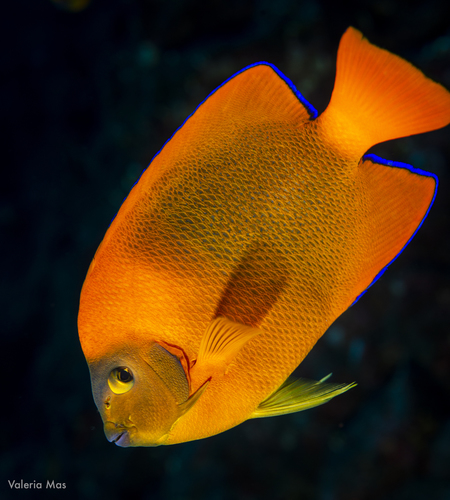
The Clarion angelfish, scientifically named Holacanthus clarionensis Gilbert, 1890, has a laterally compressed, quadrilateral body. It has a small mouth fitted with bristle-like teeth, and this species reaches a maximum total length of 20 centimetres (7.9 in). Juvenile Clarion angelfish have an overall yellowish-orange colour across their body and fins; their body is marked with several blue vertical bars that fade and eventually disappear as the fish matures. Juveniles may also have blue lips and blue margins along their dorsal and anal fins. Adult fish have a brownish face, the area of the body immediately behind the face is reddish orange, and the posterior part of the body is browner. The dorsal and anal fins are bright orange, while the caudal fin is vermilion. The dorsal fin has 14 spines and 17 to 19 soft rays, and the anal fin has 3 spines and 19 soft rays. Clarion angelfish have a very limited range in the Eastern Pacific Ocean, and are largely restricted to the Revillagigedo Islands of Mexico. Vagrant individuals have occasionally been recorded from the southern tip of Baja California, the southeastern Gulf of California, and Clipperton Island, a French territory. This species lives on rocky reefs at depths up to 30 metres (98 ft), and is typically found either as solitary individuals or in shoals. It is a little studied species.