About Holacanthus ciliaris (Linnaeus, 1758)
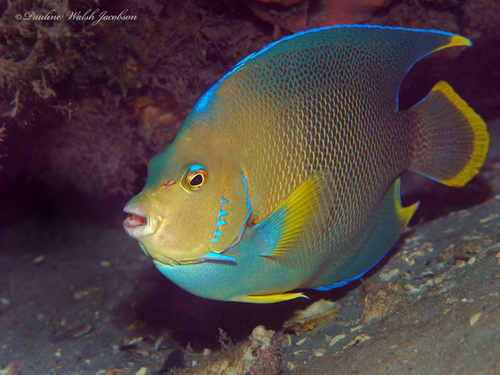
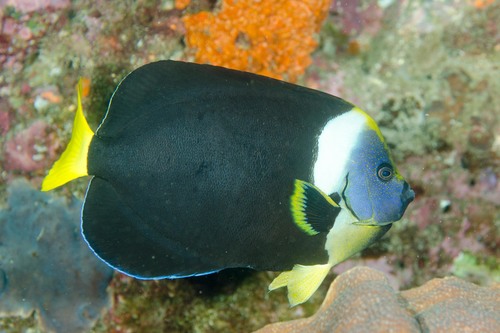
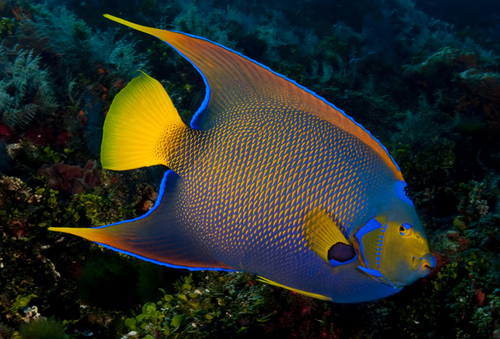
The queen angelfish (Holacanthus ciliaris) has a broad, flattened, oval-shaped body, a triangular tail fin, a reduced, dulled snout, and a small mouth holding bristle-like teeth. Its dorsal fin has 14 spines and 19–21 soft rays, while the anal fin has 3 spines and 20–21 soft rays; both the dorsal and anal fins extend past the main body. This species reaches a maximum total length of 45 cm (18 in) and a maximum weight of 1,600 g (56 oz), and males are often larger than females. The body is covered in blue-green scales tipped with yellow, and the tail, pectoral, and pelvic fins are bright yellow. The dorsal and anal fins both have orange-yellow tips, and the pectoral fins have blue patches at their base. On the forehead sits a distinctive cobalt blue, eye-like spot or "crown" outlined with an electric blue outer ring and dotted with electric blue spots. This crown is the primary feature that distinguishes queen angelfish from Bermuda blue angelfish. Juvenile queen angelfish are dark blue with bright blue vertical stripes and a yellow area around the pectoral fins. They resemble juvenile blue angelfish, and can be told apart by their more curved vertical stripes. As juveniles grow, they develop transitional color patterns before gaining full adult coloration. Seven distinct non-typical color morphs have been recorded off the coast of Brazil's Saint Peter and Saint Paul Archipelago. The most common morph is mostly gold or bright orange; other morphs may be bright blue with patches of yellow, black, or white, or entirely white. An additional color morph was recorded off Florida's Dry Tortugas in 2009, which was mostly cobalt blue with white and yellow-orange patches. At least two wild queen angelfish with the skeletal deformity known as "pughead" have been recorded at Saint Peter and Saint Paul Archipelago. This deformity causes a squashed upper jaw and a protruding lower jaw, and it most commonly occurs in captive fish. Queen angelfish live in tropical and subtropical regions of the Western Atlantic Ocean, around the coasts and islands of the Americas. Their range extends from Florida, through the Gulf of Mexico and Caribbean Sea, south to Brazil, and east as far as Bermuda and the Saint Peter and Saint Paul Archipelago. They are benthic (bottom-dwelling) fish found from shallow nearshore waters down to 70 m (230 ft). They inhabit coral reefs, with a preference for soft corals, and they typically swim alone or in pairs. Queen angelfish feed on sponges, tunicates, jellyfish, corals, plankton, and algae. Juveniles act as cleaner fish, establishing cleaning stations where they remove ectoparasites from larger fish. Off St. Thomas Island and Salvador, Bahia, 90% of an adult queen angelfish's diet is made up of sponges. Off the Saint Peter and Saint Paul Archipelago, queen angelfish may eat more than 30 different prey species: 68% of their diet is sponges, 25% is algae, and 5% is bryozoans. Queen angelfish are selective feeders, as the proportion of a prey type in their diet does not match how abundant that prey is in their habitat. At the Saint Peter and Saint Paul Archipelago, this species specifically targets the less common sponge species Geodia neptuni, Erylus latens, Clathria calla, and Asteropus niger. Male queen angelfish hold large territories that contain a harem of two to four females. Little is known about the species' sexual development, but they are presumed to be protogynous hermaphrodites, which means the largest female in a harem can transform into a male if the existing territorial male disappears. Around midday, each female in the harem forages alone in a separate area. The male visits each female, rushing toward her, circling her, and feeding beside her. Spawning occurs year-round, and it is typically observed around the time of a full moon. During courtship, the male displays his side to the female, flicks his pectoral fins toward her, or soars above her. To begin spawning, the female swims upward toward the water surface while the male follows under her, pressing his snout against her vent. The pair then releases eggs and semen into the open water. A female can release between 25,000 and 75,000 eggs per spawning day. After spawning, the pair separates and returns to the ocean floor. The transparent eggs are pelagic, and stay suspended in the water for 15–20 hours after release. When larvae hatch, they have a large yolk sac and no functional eyes, gut, or fins. After two days, the yolk sac is fully absorbed, and the larvae begin to resemble typical fish. These young larvae feed on plankton and grow quickly. When they are between three and four weeks old, and have reached a length of 15 to 20 mm (0.6 to 0.8 in), they descend to the seabed as juveniles. Juvenile queen angelfish live alone, holding territories around finger sponges and coral, where they maintain cleaning stations to clean parasites from other fish.