About Holacanthus bermudensis Goode, 1876
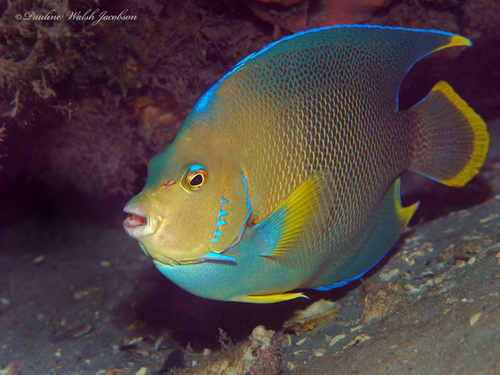
Holacanthus bermudensis has a deep, oval-shaped body that is strongly laterally compressed. It has a short snout and a small mouth that holds small, brush-bristle-like teeth. Juveniles have a yellowish anterior body that shifts to brownish-yellow halfway along the body. Their caudal, pectoral, and pelvic fins are vivid yellow, they have multiple vertical white bars across the body, and their dorsal and anal fins have bright blue margins. Adults have a bluish yellowish body with a vivid yellow face, blue highlights on the chest and forehead, and blue and yellow pectoral fins. Their caudal fin has yellow margins, while the dorsal and anal fins also have yellow margins and long yellow streamers. The dorsal fin has 15 spines and 19–21 soft rays, and the anal fin has 3 spines and 20–21 soft rays. This species reaches a maximum total length of 45 centimetres (18 in). This species occurs in the western Atlantic, ranging from North Carolina to Bermuda, through the Bahamas and Florida to the Gulf of Mexico, extending west to Yucatan, Mexico, and east to Puerto Rico and the Virgin Islands. Holacanthus bermudensis is a benthic species that lives close to the seabed around areas of sponges, coral, or rock, at depths between 2 and 93 metres (6.6 and 305.1 ft). It is diurnal, active during daylight and hiding within reefs at night. Juveniles prefer more sheltered habitats such as bays, channels, and inshore reefs. The diet of this species is largely made up of sponges, though individuals have occasionally been recorded feeding on tunicates, corals, and algae. Juveniles act as cleaner fish, feeding on ectoparasites removed from the skin of other fish that visit communal cleaning stations. This species is able to produce loud thumping sounds, which are thought to startle predators and draw the attention of conspecifics.