About Holacantha emoryi A.Gray
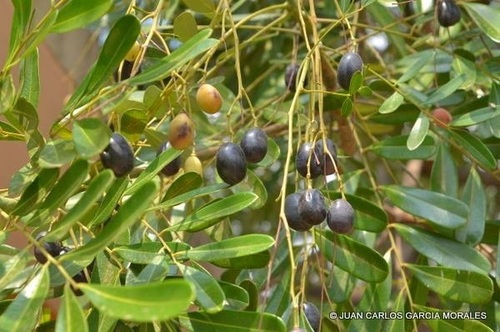
This species, also referred to as Castela emoryi and commonly known as crucifixion thorn, most often grows under 1 metre (3.3 ft) tall, and occasionally reaches 4 metres (13 ft) or more in height. It is mostly leafless, with sharp green branches that carry out photosynthesis. Its seeds develop within clustered fruit groups that each contain 5 fruits. The fruit can be tan, green, red, or brown, turns black as it ages, and may remain on the plant for several years. Within California, the species is listed as endangered on the California Native Plant Society Inventory of Rare and Endangered Plants, and it is more common in other parts of its range. In its California distribution, the species is threatened by solar energy development and military activities. It is classified as "Salvage restricted" in the state of Arizona. This plant is native to the Mojave and Sonoran Deserts of North America, and can be found in southern California, Arizona, and the Mexican state of Sonora. The species is dioecious, grows in the moistest available locations within the hottest, driest sections of the deserts it inhabits, and is known to have poor germination rates. Castela emoryi is one of the few plants in its native habitat that blooms during mid-summer heat, and it acts as an important resource source for insects during this period. Ants collect its nectar, and pollination is carried out by wasps and bees, most notably bumblebees. The Yavapai people have traditionally used this plant as medicine, preparing a dermatological aid from the sap of its buds.