About Hoheria angustifolia Raoul
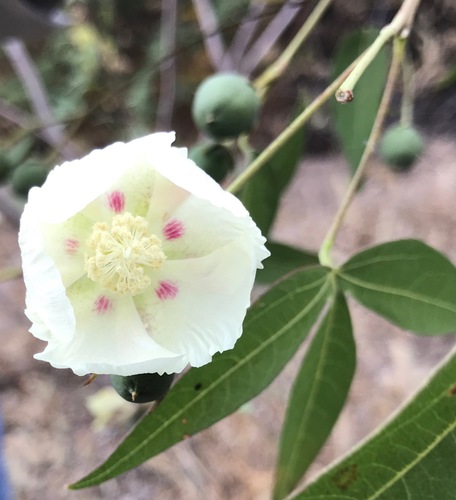
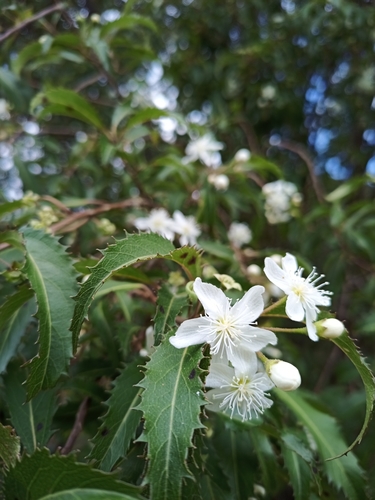
Hoheria angustifolia, commonly called narrow-leaved lacebark or narrow-leaved houhere, is a species of flowering plant in the family Malvaceae that is endemic to New Zealand. In Māori, this plant is known as houhere or houhi. It is an evergreen tree or shrub with a weeping growth form, reaching up to 10 m (33 ft) in height. The published literature most commonly cites that its diameter at breast height (DBH) reaches up to 30 centimetres (12 in), but botanist Hugh Wilson discovered a specimen in Hinewai Reserve with a DBH of 130 centimetres (51 in). When young, this species grows as a divaricating plant with small leaves, keeping this habit until it reaches roughly 2 m (7 ft) tall. Mature leaves are narrow with coarse teeth, which gives the species its common name of narrow-leaved lacebark. The leaves themselves are grey-green to dark green, and the plant produces white flowers between December and February. The bark of this tree was occasionally used to make traditional textiles, a use that matches the traditional use of the related species Hoheria populnea. It has a larger distribution range than any other species of lacebark: it grows mostly in the eastern South Island of New Zealand, and in the North Island from Taranaki southwards.