About Hirundo rustica Linnaeus, 1758
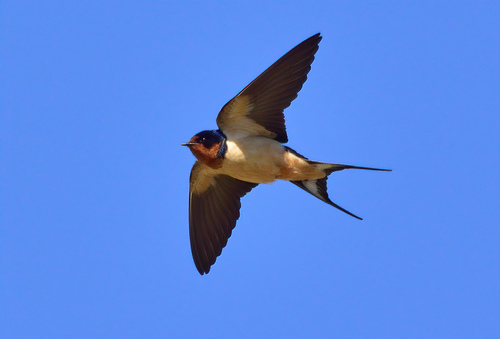
The adult male nominate subspecies Hirundo rustica rustica, the barn swallow, measures 17–19 cm (6+1⁄2–7+1⁄2 in) in total length, which includes 2–7 cm (1–3 in) of elongated outer tail feathers. It has a wingspan of 32–34.5 cm (12+1⁄2–13+1⁄2 in) and weighs 16–22 g (9⁄16–3⁄4 oz). Its upperparts are steel blue, and its forehead, chin and throat are rufous. A broad dark blue breast band separates this rufous area from the bird's off-white underparts. Its elongated outer tail feathers create the distinctive deeply forked 'swallow tail', with a line of white spots across the outer end of the upper tail. The adult female has a similar appearance to the male, but its tail streamers are shorter, the blue of its upperparts and breast band is less glossy, and its underparts are paler. Juvenile barn swallows are browner, have a paler rufous face and whiter underparts, and lack the long tail streamers of adults. While both sexes sing, female song was only described in recent years. Common calls include witt or witt-witt, and a loud splee-plink when the bird is excited or chasing intruders away from the nest. Alarm calls are a sharp siflitt for predators like cats, and a flitt-flitt for birds of prey like the hobby. This species is fairly quiet when on its wintering grounds. The unique combination of a red face and blue breast band makes adult barn swallows easy to tell apart from African Hirundo species and the welcome swallow (Hirundo neoxena), which shares overlapping range with the barn swallow in Australasia. In Africa, juvenile barn swallows with short tail streamers can be confused with juvenile red-chested swallows (Hirundo lucida), but red-chested swallows have a narrower breast band and more white in the tail. The barn swallow's preferred habitat is open country with low vegetation, such as pasture, meadows and farmland, and it prefers areas that are close to water. This species avoids heavily wooded or steep areas, as well as densely built-up locations. For breeding range selection, the presence of accessible open structures (such as barns, stables, or culverts) for nesting sites, and exposed locations (such as wires, roof ridges or bare branches) for perching, is also important. Barn swallows are semi-colonial, settling in groups ranging from a single pair to a few dozen pairs, particularly in large wooden structures that house animals. The same individuals often return to breed at the same site year after year. Experimental studies show that settlement choices are predicted by nest availability rather than any characteristics of available mates. Because a pair takes around 2 weeks to build a new nest from mud, hair, and other materials, old nests are highly valued. This species breeds across the Northern Hemisphere from sea level to 2,700 m (8,900 ft), and reaches up to 3,000 m (9,800 ft) in the Caucasus and North America. It is only absent from deserts and the cold northernmost parts of Northern Hemisphere continents. Across most of its range, it avoids towns, and in Europe it is replaced in urban areas by the house martin. However, in Honshū, Japan, the barn swallow is a more urban bird, and the red-rumped swallow (Cecropis daurica) replaces it as the rural species. In winter, the barn swallow uses a wide variety of habitat types, only avoiding dense forests and deserts. It is most common in open habitats with low vegetation, such as savanna and ranch land. In Venezuela, South Africa and Trinidad and Tobago, it is specifically noted to be attracted to burnt or harvested sugarcane fields and cane waste. When no suitable roost sites are available, they may sometimes roost on wires, which leaves them more exposed to predators. Individual barn swallows tend to return to the same wintering locality each year, and congregate from a large area to roost in reed beds. These roosts can be extremely large; one roost in Nigeria had an estimated 1.5 million birds. These roosts are thought to protect birds from predators, and roosting birds arrive in a synchronized way to overwhelm predators like African hobbies. The barn swallow has been recorded breeding in the more temperate parts of its winter range, such as the mountains of Thailand and central Argentina. Migration of barn swallows between Britain and South Africa was first confirmed on 23 December 1912, when a bird ringed by James Masefield at a nest in Staffordshire was found in Natal. As expected for a long-distance migrant, this bird has appeared as a vagrant in distant areas including Hawaii, Bermuda, Greenland, Tristan da Cunha, the Falkland Islands, and even Antarctica.