About Hirundo neoxena Gould, 1842
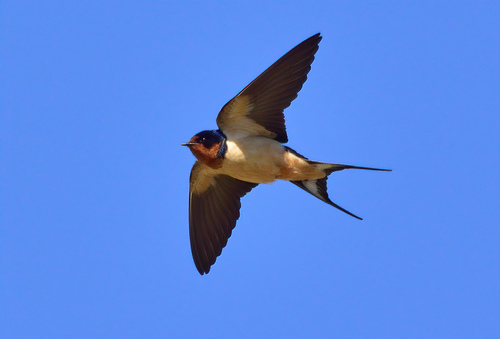
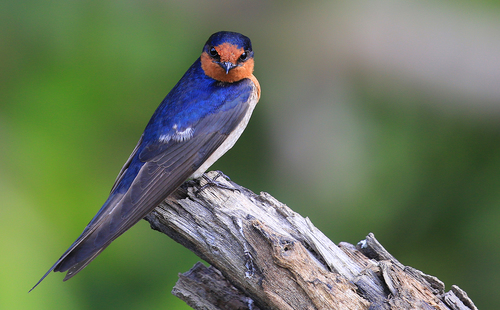
The welcome swallow (Hirundo neoxena Gould, 1842) is a small, fast-flying bird with a graceful shape. Its flight follows a circular pattern made up of swift darting motions, and it may fly alone, in pairs, or in flocks. This species is metallic blue-black on its upperparts, light grey on the lower breast and belly, and rusty colored on the forehead, throat, and upper breast. It has a long forked tail, with a row of white spots on each individual tail feather. Adults are approximately 15 cm (5.9 in) long in total; females have slightly shorter outer tail feathers than males. Adult welcome swallows weigh between 9 and 20 grams. Measurements from a 'natural size' male from the Gould collection in Tasmania record a wing length of 11.1 cm (4.4 in), tail length of 7.4 cm (2.9 in), and culmen length of 0.7 cm (0.28 in). The female from the same collection measured 10.9 cm (4.3 in) for wing length, 6.25 cm (2.46 in) for tail length, and 0.7 cm (0.28 in) for culmen length. The welcome swallow's call is a mix of twittering and soft warbling notes, with a sharp whistle used as an alarm call. Their calls are typically quiet and do not carry far. Juvenile welcome swallows have buffy white rather than rufous coloring on the forehead and throat, and shorter tail streamers. In winter, the northern Australian winter range of the welcome swallow overlaps with that of the wintering barn swallow (Hirundo rustica), which can be easily distinguished by its blue breast band. Welcome swallows readily breed close to human habitations, and are commonly seen perching on wires, posts, and other similar structures. The welcome swallow has a very large global distribution, as it is a cross-regional species. It lives mostly in eastern, western, southern, and central Australia. Eastern Australian populations of welcome swallow migrate to northern Australia for winter, while populations in Western Australia and New Zealand are mostly non-migratory. This swallow species has been observed nesting across most of New Zealand and its surrounding islands, throughout Australia, and in parts of Tasmania. It has also been recorded in New Guinea, New Caledonia, and other nearby islands. Its distribution shifts with seasonal change: during winter, Australian welcome swallows move north toward the equator to warmer areas, returning to southern Australia to breed in the following spring. The welcome swallow is a self-introduced species that flew to New Zealand from Australia, believed to have arrived in the early 1900s. It is found across most of New Zealand, but is very rare in Fiordland. It is also present on the Chatham and Kermadec Islands, and has occasionally been seen on Campbell Island, Auckland Island, and the Snares. The long narrow shape of New Zealand has made it easy for the species to reach areas near water. While welcome swallows are most often found near coastal and wetland areas, they can live in almost all habitat types, with the exception of alpine areas and very dense forest. They have been recorded in open areas including farmlands, grasslands, partly cleared wooded areas, lands near bodies of water such as lakes or reservoirs, and along coastlines. This species is well-adapted to urban and suburban life, and can even live in high altitude areas because humans provide nesting materials. During winter, welcome swallows move to warmer habitats that can supply enough food and safe shelter. Welcome swallows are extremely agile fliers that feed on insects while flying. They often fly fast and low to the ground over open fields in large circles or figure-eight patterns, and frequently swoop around animals or people in open areas. During the breeding season, males and females tend to forage together, even when there are fledglings in the nest. Welcome swallows have a habit of drinking water while flying, scooping water into their bills from the surfaces of lakes and ponds. They need to drink water frequently, and this behavior also allows them to catch insects from the water. Welcome swallows may cooperate with other birds or flock members to herd insects together, and can remember the activity routines of insects to make foraging more efficient. Research has found that welcome swallows have slow growing wings that are not affected by food intake unless the bird is starving. This indicates that the species prioritizes wing growth even when fasting for up to six hours. It is also thought that welcome swallows accumulate fat to survive periods when food is scarce or conditions are poor, allowing for rapid growth when conditions are good and stable growth when conditions are bad.