About Hirundinea ferruginea (Gmelin, 1788)
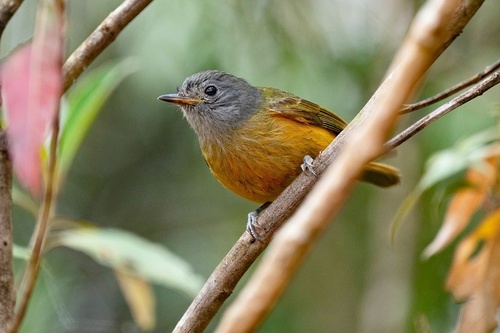
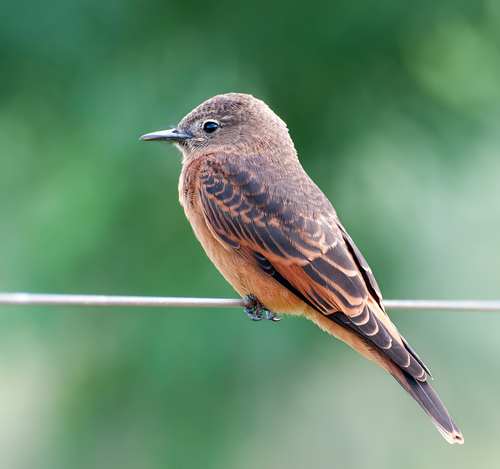
Hirundinea ferruginea, commonly known as the cliff flycatcher, is 15.5 to 18.5 cm (6.1 to 7.3 in) long and weighs 21 to 42 g (0.74 to 1.5 oz). Both sexes share the same plumage. Adults of the nominate subspecies H. f. ferruginea have a brown crown and brown sides of the head, a grayish forehead and grayish ear coverts, a whitish supercilium, and a dark line running through the eye. Their upperparts are brown. Their primary wing coverts are blackish brown with bright orange bases. Their secondary coverts and tertials are dark brown. Their primaries and secondaries are mostly orange, with dark brown tips that extend up the outer webs of most of these feathers. Their tail is brown to sooty black. Their chin is mottled brownish to gray, while their throat and underparts are a rich cinnamon-rufous. Juveniles are similar to adults but are paler and duller overall across their body. The other three subspecies differ from the nominate subspecies and from each other in the following ways: H. f. sclateri has bright tawny to rufous inner webs on most tail feathers, more gray mottling on the face, and a paler chin than the nominate. H. f. bellicosa has very little gray coloring on the face, dusky mottling on the cheeks and chin, mostly rufous-brown upperparts with an orange-brown rump, orange-brown uppertail coverts, and orange-brown tail base, and more rufous edging on wing feathers than the nominate. H. f. pallidior is paler overall than the nominate, with wider tawny-rufous edges on its wing coverts. All subspecies have a brownish olive to yellowish olive iris, a black bill with a wide base, and slate to blackish legs and feet. The cliff flycatcher has a highly disjunct distribution, with each subspecies occupying a separate range. The nominate subspecies H. f. ferruginea is found from southeastern Colombia east across southern Venezuela and northwestern Brazil into Guyana, and also in eastern Suriname and French Guiana. H. f. sclateri is found in the Andes of western Venezuela, in the Serranía del Perijá along the Venezuela-Colombia border, in the isolated Sierra Nevada de Santa Marta in northern Colombia, and intermittently from Colombia's Central and Eastern Andes south along the eastern Andean slope through Ecuador into Peru as far as Cuzco Department. H. f. bellicosa is found in eastern and southern Brazil, ranging from southern Pará east to the Atlantic coast and south to eastern Bolivia, eastern Paraguay, Misiones Province in northeastern Argentina, and most of Uruguay. H. f. pallidior ranges across central Bolivia into western Paraguay and south in western Argentina to Mendoza and San Luis provinces. There are unconfirmed records of the species in Chile, leading the SACC to classify it as hypothetical in that country. The cliff flycatcher inhabits vertical landscapes located near or within forest, including cliffs, gorges, canyons, rocky outcrops, quarries, and road cuttings. In the southern parts of its range, it also uses human structures such as buildings and bridges. In eastern Brazil, it is found in Eremanthus forest and campo rupestre. Its elevation range varies by location: it occurs from sea level to 2,000 m (6,600 ft) in Brazil. In Venezuela, it ranges between 1,000 and 2,500 m (3,300 and 8,200 ft) north of the Orinoco River, and between 100 and 1,900 m (300 and 6,200 ft) south of the river. It reaches 1,600 m (5,200 ft) in Colombia, ranges between 900 and 1,700 m (3,000 and 5,600 ft) in Ecuador, mostly ranges from 400 to 2,200 m (1,300 to 7,200 ft) but can reach locally 2,700 m (8,900 ft) in Peru. It reaches 3,900 m (12,800 ft) in Bolivia and 3,500 m (11,500 ft) in Argentina.