About Hirundapus caudacutus (Latham, 1801)
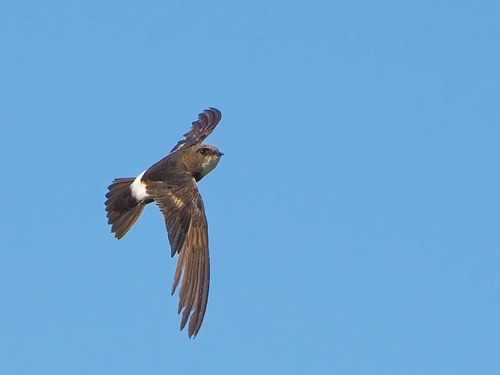
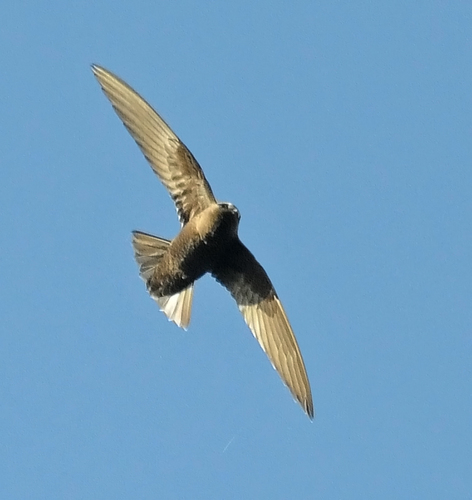
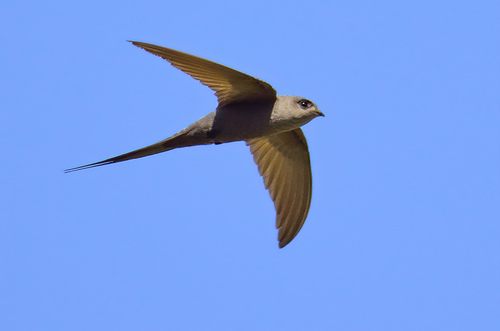
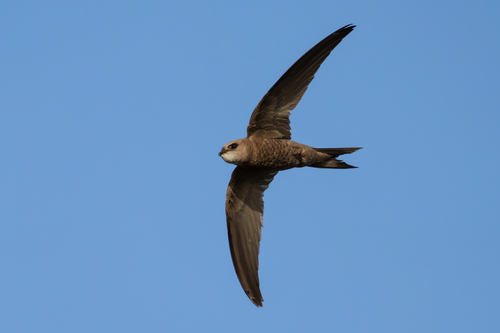
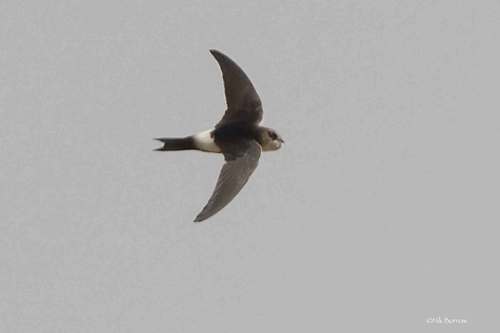
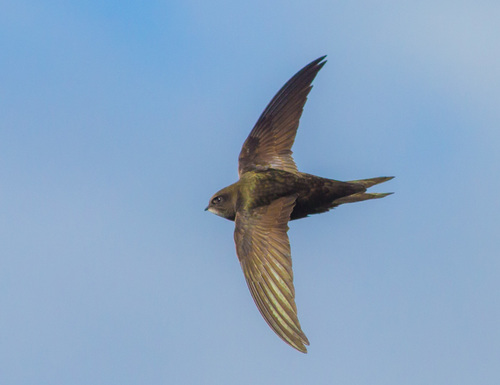
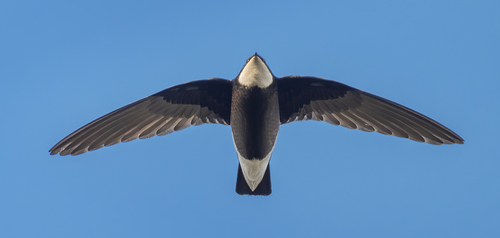
The white-throated needletail, Hirundapus caudacutus, is also commonly called the needle-tailed swift or spine-tailed swift. It is a large swift species belonging to the genus Hirundapus. There are unconfirmed claims that this bird can reach horizontal flight speeds of up to 170 km/h (110 mph), as the speed measurement methods have never been published. A more likely maximum speed is 75 km/h (47 mph), which is still at least 100 times the bird’s body length per second. White-throated needletails build their nests in rock crevices on cliffs or inside hollow trees. They avoid landing on the ground and spend almost all of their time airborne. They feed on small flying insects, including beetles, flies, bees, and moths. This is a migratory species: it breeds in Central Asia and southern Siberia, and spends the winter further south in the Indian subcontinent, Southeast Asia, and Australia. It is a rare vagrant to Western Europe, and has been recorded as far west as Norway, Sweden, and Great Britain. In June 2013, an individual was spotted in Great Britain for the first time in 22 years. The bird later collided with a wind turbine and died, and its body was sent to a museum. In June 2022, a white-throated needletail was recovered by the expedition ship MV Ortelius near Fair Isle, approximately 70 miles off Duncansby Head, Caithness, Scotland, and was successfully released. In October 2025, an individual was spotted at Tophill Low Nature Reserve in East Yorkshire, England. White-throated needletails are large swifts with a robust, barrel-shaped body. They measure around 20 cm in length, and weigh between 110 and 120 grams. Their plumage is mostly greyish-brown, with the exception of a white throat and a white patch that extends from the base of the tail to the bird’s flanks. The common name needle-tailed swift comes from the spined tip of its tail, which is not forked like the tails of typical swifts in the genus Apus. English ornithologist John Latham first described this species in 1801, under the original binomial name Hirundo caudacuta. Its current genus name Hirundapus combines the names of the swallow genus Hirundo and the swift genus Apus. The specific epithet caudacutus derives from Latin: cauda means "tail", and acutus means "pointed".