About Hirudo medicinalis Linnaeus, 1758
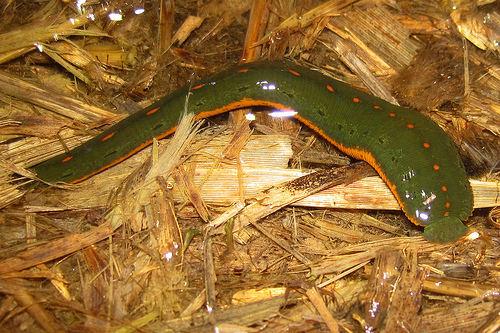
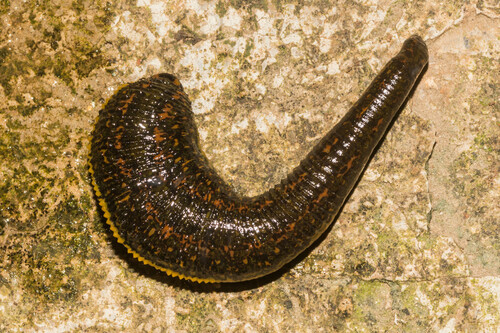
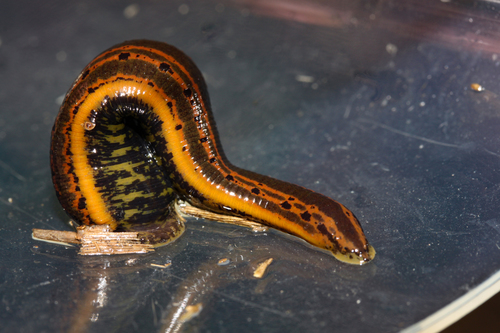
Hirudo medicinalis, the European medicinal leech, shares the general body structure common to most other leeches. Fully mature adults can reach up to 20 centimeters in length. Their body color can be green, brown, or greenish-brown, with a darker tone on the dorsal side and a lighter ventral side. A thin red stripe also runs along the dorsal side. This species has two suckers, one at each body end, called the anterior and posterior suckers. The posterior sucker is used mainly for leverage, while the anterior sucker, which contains the jaw and teeth, is the structure used for feeding. Medicinal leeches have three tripartite saw-like jaws, which carry around 100 sharp cutting edges to incise host skin. The incision they leave forms a mark shaped like an inverted Y inside a circle. After piercing host skin, they suck out blood while injecting hirudin, an anticoagulant blood thinner chemically similar to anophelins. Large adult individuals can consume up to ten times their body weight in a single feeding, with an average blood meal volume of 5 to 15 mL. These leeches can survive up to one year between meals. Medicinal leeches are hermaphrodites that reproduce through sexual mating. They lay their eggs in clutches of up to 50, in shaded, humid locations located near (rather than under) water. A study conducted in Poland found that medicinal leeches sometimes breed inside the nests of large aquatic birds, which means that conservation work focused on bird habitats can also indirectly help preserve declining leech populations.
The natural range of Hirudo medicinalis covers almost all of Europe, extending into Asia as far east as Kazakhstan and Uzbekistan. This species prefers muddy freshwater pools and ditches with abundant weed growth, in temperate climates. Over-exploitation by commercial leech collectors in the 19th century left the species with only scattered remaining populations. Habitat loss from wetland drainage has also contributed to its population decline. An additional contributing factor is the replacement of horses, the species' preferred historical host, by motor vehicles and mechanical farming equipment, as well as the shift to artificial water supplies for cattle. As a result of these declines, the IUCN now lists this species as near threatened, and it receives legal protection across nearly all of its natural European range. It is particularly sparsely distributed in France and Belgium. In the United Kingdom, there may be as few as 20 remaining isolated, widely scattered populations. The largest of these, located at Lydd, England, is estimated to hold several thousand individuals, and 12 of these UK populations occupy designated Sites of Special Scientific Interest. Small transplanted populations of the species have been established in several countries outside its natural range, including the United States of America. Hirudo medicinalis is listed under Appendix II of CITES, which means all international trade in the species, including trade in its parts and derivatives, is regulated through the CITES permitting system.