About Hipposideros speoris (Schneider, 1800)
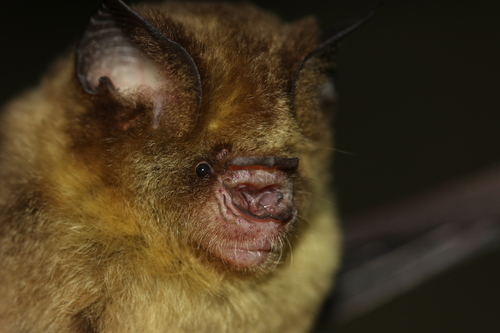
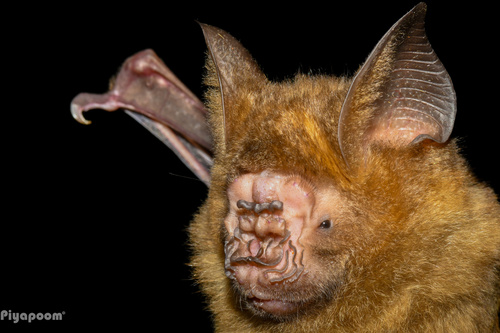
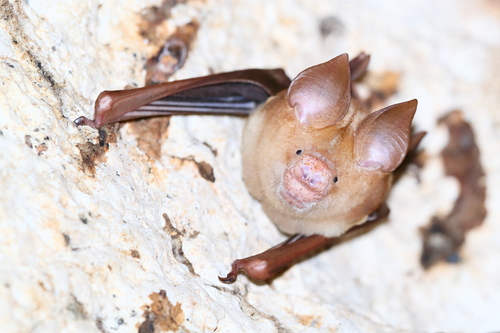
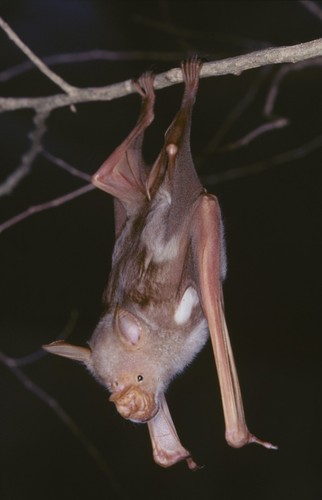
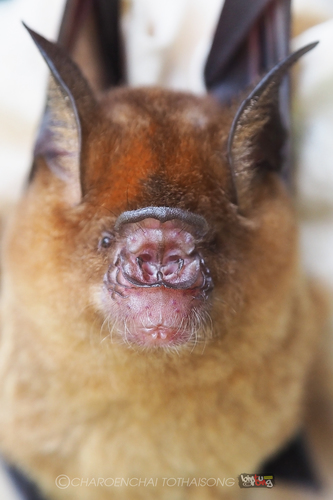
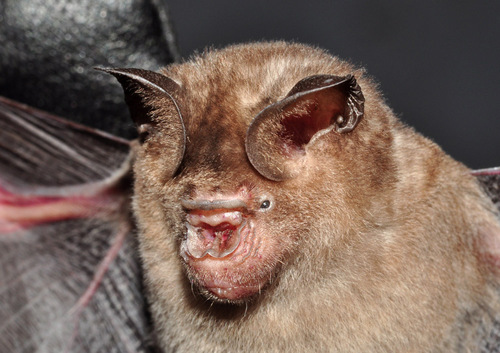
Hipposideros speoris is a small bat species. It can be distinguished externally from other species in the genus Hipposideros by three additional leaflets on its leaf-nose, where the outermost leaflet is smaller than the other two, plus well-developed lappets located next to the nostrils. A frontal sac is also present above the leaf-nose. Individuals of this species vary in color from gray to orange-brown; they are palest between the shoulders and on the ventral side, and darker on the flanks and posterior side. H. speoris has a tiny baculum that is just 0.57 mm in length, with a blunt tip and slightly expanded base. This bat is found in India (specifically in Andhra Pradesh, Gujarat, Karnataka, Kerala, Maharashtra, Orissa, Tamil Nadu, Telangana, and Uttarakhand), Sri Lanka, and has more recently been recorded in Pyay, Myanmar. It has been recorded at elevations up to 1,285 m (4,216 ft) above sea level. It is common and widespread across its entire range, and roosts in groups of up to 1,000 individuals. These bats typically roost in caves, caverns, underground cellars, old forts, palaces, under bridges, old disused buildings, temples, and tunnels, found across dry plains or forested hillsides. Roosting groups in India are more scattered, while bats in Sri Lanka roost closely together. This bat has a gestation period of 135 to 140 days, after which a single young is born. Newborns have closed eyes, laterally folded ears, hairless bodies, a dark dorsal side, and a pink ventral side. Eye slits appear after one week, and eyes are fully opened after two weeks. Newborns lift their ears on the tenth day, and ear movements become noticeable two weeks after birth. By around one month old, juveniles have fur as dense as adult fur, though the juvenile fur is darker in color. While sucking from one of their mother's two pubic teats, juvenile bats attach to their mother's body in a reversed position. Most females carry their newborns with them when they fly out of the cave to forage, and most leave their infants inside the cave once the infants are older than 7 days. Mothers return regularly before midnight to retrieve their young. During retrieval, the mother moves toward her infant, gently touches it with her forearm, and presents her ventral surface, especially the pubic region. When the infant attempts to cling to the mother's body, she turns her body to an angle of around 45 degrees by partly spreading her wing membranes. This posture allows the baby to grip the mother's pubic teats and release its hold on the rock. The infant then turns toward the mammary glands, and after suckling, it repeatedly stretches one or both of its wings. Mothers apparently spend most of the night inside the cave.