About Hippopus hippopus (Linnaeus, 1758)
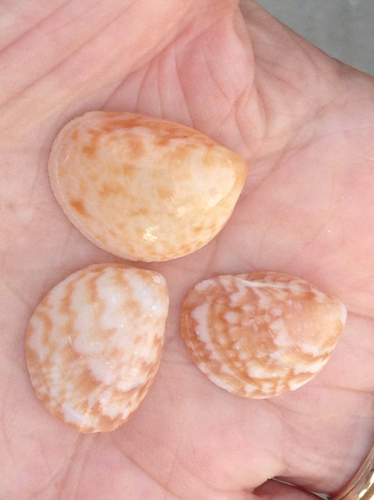
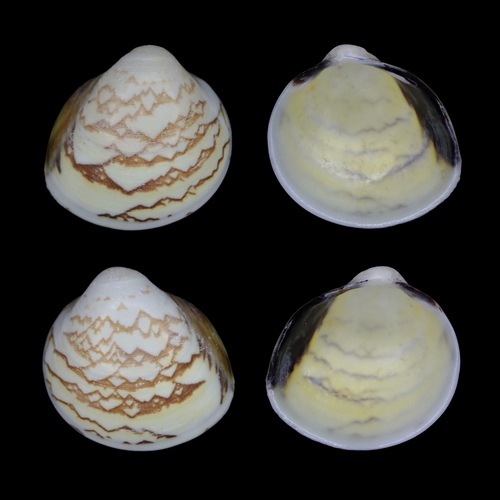
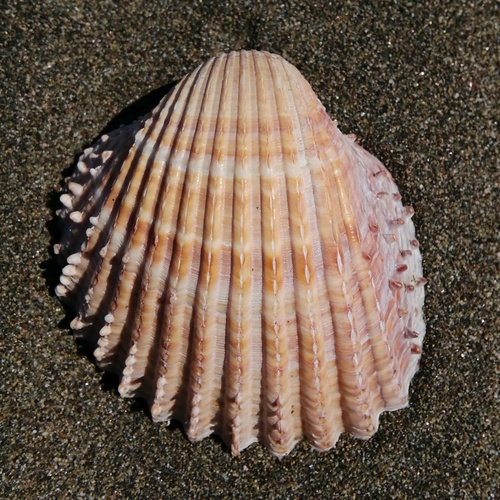
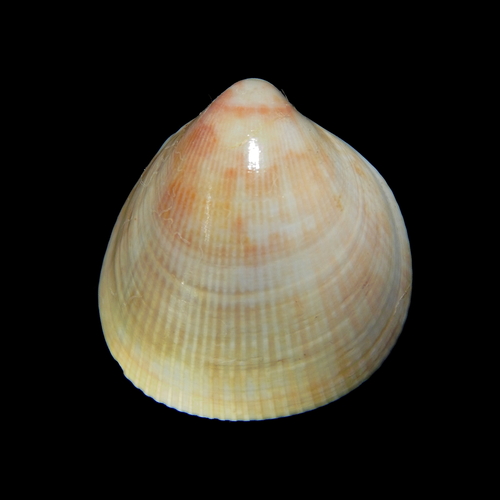
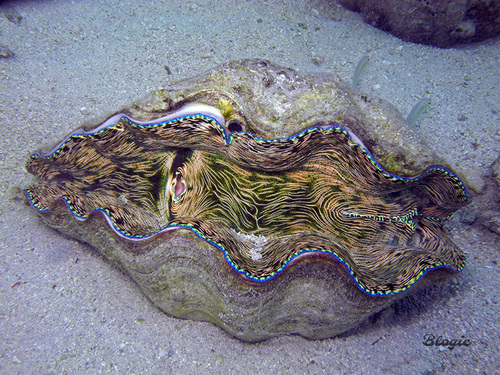
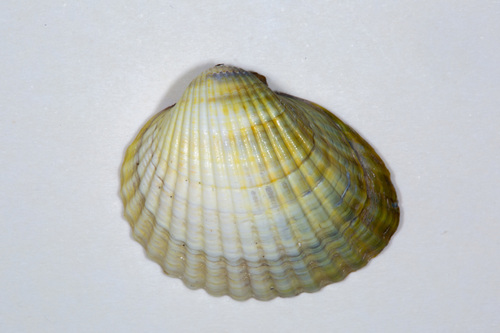
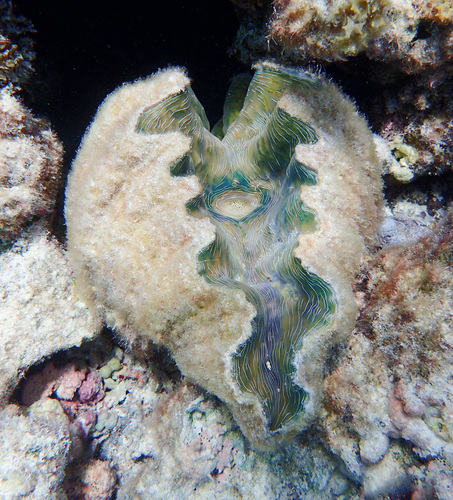
Anatomy and morphology: The shell of Hippopus hippopus has band-shaped strawberry blotches on its outer surface. The mantle is green-yellow, with tightly fitting interlocking ridges. The shell has a sub-rhomboidal shape, and features deep vertical ridges that run across its entire surface. H. hippopus is an average-sized member of the tridacnine clam group, with a typical average length of 22 cm (8.7 in) and a maximum recorded length of 45 cm (18 in). Unlike most other bivalves, the hinge of H. hippopus is positioned adjacent to the substrate, while its inhalant siphon and mantle tissues face toward the water surface. This orientation maximizes photosynthetic ability of the symbiotic photosynthetic dinoflagellates living in the clam's tissues; these dinoflagellates capture sunlight, and also produce the distinct vibrant pigmentation seen in this species. Distribution and habitat: H. hippopus lives in tropical waters across the Indian and Pacific Oceans. It is very common along the coasts of Indonesia and Palau. The species' range extends west as far as India in the Indian Ocean, and east as far as Kiribati in the Pacific Ocean. H. hippopus most often inhabits shallow waters of fringing reefs, barrier reefs, and seagrass beds. Shallow water allows its symbiotic organisms to use sunlight for photosynthesis to support the clam. H. hippopus does not attach to reef rocks; instead, it settles on open sandy patches, remaining detached from any reef rock. Reproduction: H. hippopus clams are protandrous hermaphrodites. They first develop male gonads, and eventually become fully hermaphroditic after female gonadal cells grow and mature. To reproduce, individuals first release sperm into the water column, then expel eggs that are fertilized externally. This release of reproductive cells triggers other nearby H. hippopus clams to also release their sperm and eggs, which increases the chance that eggs will be fertilized in the water column. Released egg cells remain viable for approximately 4 to 6 hours. As a result, larger communities of H. hippopus have higher reproductive success, due to the higher total volume of reproductive cells present in the water.