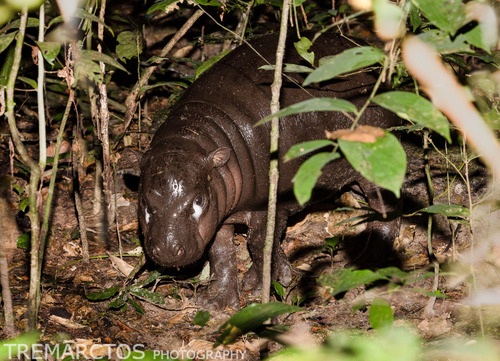
About Hippopotamus amphibius Linnaeus, 1758
Hippopotamus amphibius Linnaeus, 1758 (common hippopotamus) is a megaherbivore, and the third largest land mammal, after elephants and some rhinoceros species. The average adult weight is around 1.48 tonnes (1.63 short tons) for males (bulls) and 1.365 tonnes (1.505 short tons) for females (cows). Exceptionally large males have been recorded reaching 2.66 tonnes (2.93 short tons). Males appear to continue growing throughout their lives, while females reach their maximum weight around age 25. Total body length ranges from 2.90 to 5.05 m (9 ft 6 in to 16 ft 7 in), including a tail that measures 35 to 56 cm (1 ft 2 in to 1 ft 10 in). Shoulder height ranges from 1.30 to 1.65 m (4 ft 3 in to 5 ft 5 in) overall, with males measuring 1.40 to 1.65 m (4 ft 7 in to 5 ft 5 in) and females 1.30 to 1.45 m (4 ft 3 in to 4 ft 9 in) at the shoulder. The species' typical head–body length is 3.3–3.45 m (10.8–11.3 ft), with an average standing shoulder height of 1.4 m (4 ft 7 in).
Hippos have barrel-shaped bodies with short tails and legs, and an hourglass-shaped skull with a long snout. Their skeletons are graviportal, adapted to support their enormous weight. Dense bones and a low centre of gravity let them sink and move along the bottom of bodies of water. Their legs are small relative to other megafauna, because the water they live in reduces their weight burden. Their toes are webbed, and the pelvis sits at a 45-degree angle. Though they appear chubby, hippos carry very little body fat. The eyes, ears, and nostrils are positioned high on the skull, so these organs can stay above the water surface while the rest of the body is submerged. Nostrils and ears can close when underwater, and nictitating membranes cover the eyes.
The hippo's vocal folds are positioned more horizontally, similar to baleen whales. Throat tissues below the vocal folds transmit vibrations to produce underwater calls. The hippo's jaw is powered by large masseter and digastric muscles, and the jaw hinge is positioned far enough back to let the mouth open 100–110 degrees. Extensions at the back of the jaw create more surface area for muscle attachment, resulting in large, droopy cheeks, and allowing this wide gape without tearing tissue. On the lower jaw, incisors and canines grow continuously; incisors reach 40 cm (16 in), while canines can grow up to 50 cm (20 in). Lower canines are sharpened by contact with the smaller upper canines. Canines and incisors are used primarily for combat rather than feeding. The hippo jaw is too rigid for side-to-side motion, making it less efficient for chewing. Hippos use their flattened, horny lips to grasp and pull grasses, which are then moved to the molars, which have complex enamel folds on their chewing surface. The hippo is considered a pseudoruminant: it has a complex three-chambered stomach, but does not chew cud.
Hippo skin is 6 cm (2.4 in) thick across most of the body, with very little hair. The animal is mostly purplish-grey or blue-black, with brownish-pink colouration on the underside and around the eyes and ears. Their skin secretes a natural red-coloured sunscreen substance sometimes called "blood sweat", which is neither blood nor sweat. This secretion is initially colourless, turns red-orange within minutes, and eventually becomes brown. Two highly acidic pigments have been identified in the secretion: red hipposudoric acid and orange norhipposudoric acid. These pigments inhibit the growth of disease-causing bacteria, and their light-absorption peaks in the ultraviolet range, creating a sunscreen effect. All hippos secrete these pigments regardless of diet, so they do not appear to come from food; instead, they may be synthesised from precursors such as the amino acid tyrosine. This natural sunscreen cannot prevent the animal's skin from cracking if it stays out of water for too long.
Male hippos' testes do not fully descend, and a scrotum is not present. The penis retracts into the body when not erect. Female hippo genitals are unusual: the vagina is ridged, and the vulval vestibule has two large protruding diverticula. Both of these traits have unknown function. A hippo's typical lifespan is 40 to 50 years. Donna the Hippo, one of the oldest captive hippos on record, lived at Mesker Park Zoo in Evansville, Indiana, US, until her death in 2012 at age 61. Two hippos share the record for the oldest ever recorded, both living to 65 years: Bertha, a female who lived in Manila Zoo in the Philippines from its opening in 1959 until her death in July 2017, and Lu, a male born at the San Diego Zoo on January 26, 1960, who died at Ellie Schiller Homosassa Springs Wildlife State Park in June 2025 at age 65. Two other notable long-lived hippos are female Tanga (1934–1995) at Hellabrunn Zoo in Munich, Germany, and male Blackie at Cleveland Metroparks Zoo (1953–2014). As of the source record, the oldest living captive hippo is believed to be Mae Mali at Khao Kheow Open Zoo in Thailand, who will turn 60 in September 2025.
Hippopotamus amphibius arrived in Europe approximately 560–460,000 years ago, during the Middle Pleistocene. During the Pleistocene, its distribution in Europe was largely limited to Southern Europe, including the Iberian Peninsula, Italy, Greece, and probably Herzegovina, but extended into northwestern Europe including northern France, Great Britain (as far north as Stockton-on-Tees), Belgium, the Netherlands, and western Germany during interglacial periods such as the Last Interglacial (130–115,000 years ago). Ancient DNA analysis shows that Late Pleistocene European hippopotamuses are closely related to, and nested within the genetic diversity of, modern living African hippopotamuses. The youngest remains of the species in Europe date to around 40–30,000 years ago, from the Late Pleistocene of Greece and the Rhine Graben of southwest Germany.
Fossil evidence indicates that during wet periods of the Middle-Late Pleistocene, H. amphibius was widespread across the Arabian Peninsula, with remains found in the Nafud desert of northern Saudi Arabia and probable remains in the Rub' al Khali desert of southern Saudi Arabia. Remains have also been found at Shanidar Cave in northern Iraq, suggested to be Late Pleistocene in age. Archaeological evidence confirms the species was present in the Levant less than 3,000 years ago. H. amphibius was also formerly present in the Maghreb of northern Algeria and Morocco during the Middle-Late Pleistocene; historical remains of the species in this region were previously assigned to the separate species "H. icosiensis". During the African Humid Period of the early Holocene, around 10,000–4,000 years ago, the hippopotamus range extended across the Sahara, which was then an extensive savannah crossed by rivers and lakes (called the "Green Sahara"), as shown by hippopotamus remains and rock art depicting the animals.
For much of recorded history, hippos were present in the Egyptian portion of the Nile from the Sudan border to the Nile Delta, but their distribution gradually fragmented starting in the Ptolemaic and Roman periods, with particularly rapid fragmentation during the early modern period due to human persecution. Hippos had become rare in the Egyptian Nile by 1600, restricted only to the eastern delta near Damietta and the southern Nubian part of the Egyptian Nile near the Sudan border, where some records indicate they persisted into the early 19th century (though at least some of these individuals may have entered from Sudan). Reports of the slaughter of the last hippo in Natal, modern South Africa, date to the end of the 19th century.
Today, hippos are still found in rivers and lakes of northern Democratic Republic of the Congo, Uganda, Tanzania, and Kenya, north to Ethiopia, Somalia, and Sudan, west to The Gambia, and south to South Africa. Genetic evidence suggests that common hippos in Africa underwent a notable population expansion during or after the Pleistocene, linked to an increase in water bodies at the end of the era. These findings have important conservation implications, as hippo populations across the continent are currently threatened by loss of access to fresh water. Hippos are also targeted by unregulated hunting and poaching. The species is listed in Appendix II of the Convention on International Trade in Endangered Species (CITES), meaning international export and import (including of parts and derivatives) requires official CITES documentation to be obtained and presented to border authorities.
As of 2017, the IUCN Red List lists the species as vulnerable, with an estimated stable population of 115,000 to 130,000 individuals. The hippo population has declined most sharply in the Democratic Republic of the Congo. By 2005, the population in Virunga National Park had fallen to 800 or 900, from around 29,000 in the mid-1970s. This decline is linked to disruptions caused by the Second Congo War. Poachers are believed to be Mai-Mai rebels, underpaid Congolese soldiers, and local militia groups. Poaching is motivated by the belief that hippos are harmful to society, as well as financial gain. As of 2016, the Virunga hippo population appears to have increased again, likely due to improved protection from park rangers who have collaborated with local fishermen. While the sale of hippo meat is illegal, black-market sales are hard for Virunga National Park officers to track. Hippo meat is highly valued in some areas of central Africa, and hippo teeth may be used as a replacement for elephant ivory.
A feral hippo population exists in Colombia, descended from captive individuals that escaped from Pablo Escobar's estate after his death in 1993. Their numbers grew to 100 by the 2020s. Ecologists recommend eradicating the population, as they breed rapidly and pose an increasing threat to humans and the local environment. Control attempts include sterilisation and culling.
Hippos are semiaquatic and require enough water to immerse in, while remaining close to grassland. They mostly live in freshwater habitats, but can also be found in estuaries. They prefer relatively still waters with gently sloping shores, though males may also occur in small numbers in faster-moving waters with rocky slopes. Like most herbivores, hippos will eat a variety of plants when offered them in captivity, but their natural diet consists almost entirely of grass, with very little consumption of aquatic plants.
Hippos spend most of the day in water to stay cool and hydrated. Just before nightfall, they leave the water to forage on land. A hippo travels 3–5 km (1.9–3.1 mi) per night, and eats around 40 kg (88 lb) of grass. By dawn, they return to the water. Despite being semiaquatic, adult hippos are not especially good swimmers, and cannot float. They rarely enter deep water; when they do, they move by bouncing off the river or lake bottom. Adult hippos surface every four to six minutes to breathe, while young hippos need to breathe every two to three minutes.
On land, hippos move by trotting, and their limb movements do not change at different speeds. When moving fast enough, they can reach an airborne stage where all limbs are off the ground. Hippos have been reported to reach speeds of 30 km/h (19 mph), but this has not been confirmed. They cannot jump, but can walk up steep banks. The hippopotamus sleeps with both brain hemispheres resting, as in all land mammals, and usually sleeps on land or in water with nostrils exposed. Even so, it can sleep while submerged, surfacing intermittently to breathe apparently without waking. Hippos appear to transition between different sleep phases more quickly than other mammals.
Due to their large size and habit of using the same feeding paths, hippos have a notable impact on the land they cross, clearing vegetation and compacting the ground. Over long periods, hippos can redirect the paths of swamps and water channels. By defecating in water, hippos transfer gut microbes that affect the biogeochemical cycle of aquatic ecosystems. On rare occasions, hippos have been filmed eating carrion, usually near water. There are also other reports of meat-eating, cannibalism, and predation. Hippo stomach anatomy lacks adaptations for carnivory, so meat-eating is likely caused by nutrient deficiency or is an abnormal behaviour.
Female hippos reach sexual maturity at five to six years of age, with a gestation period of eight months. One endocrine study found females may begin puberty as early as three or four years. Males reach maturity around 7.5 years of age. Both conceptions and births are most common during the wet season. Males have mobile sperm year-round, and can breed at any time. After becoming pregnant, a female hippo typically does not start ovulating again for 17 months. Hippos mate in water, with the female remaining mostly submerged, surfacing periodically to breathe. Females give birth in seclusion, and return to the group within 10 to 14 days. Calves are born on land or in shallow water, averaging 50 kg (110 lb) in weight and around 127 cm (50 in) in length. The female lies on her side to nurse, which can happen underwater or on land. In deep water, calves are carried on their mother's back. Mother hippos are very protective of their young, and do not allow other individuals to get too close; one female was recorded protecting her calf's carcass after the calf died. Calves may be temporarily kept in communal nurseries guarded by one or more adults, and will play together. Like many other large mammals, hippos are K-strategists, typically producing just one large, well-developed infant every couple of years, rather than multiple small, underdeveloped young multiple times per year as small mammals such as rodents do. Calves stop suckling when they reach one year of age.