About Hippophae rhamnoides L.
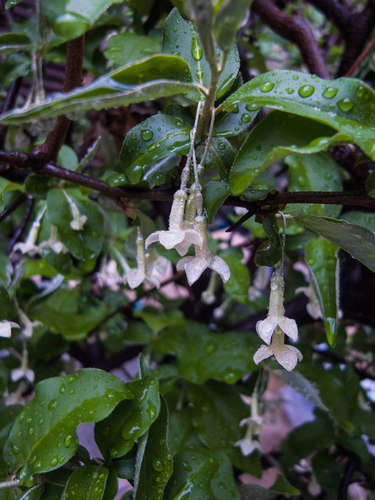
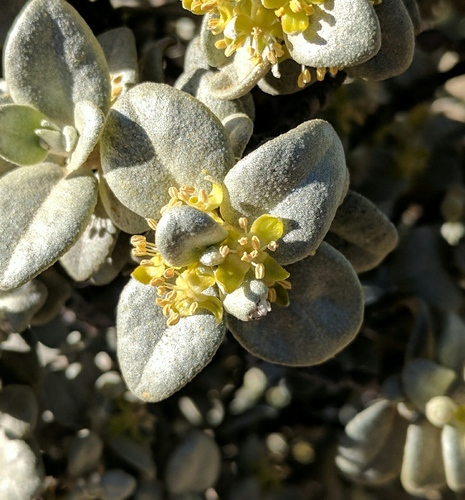
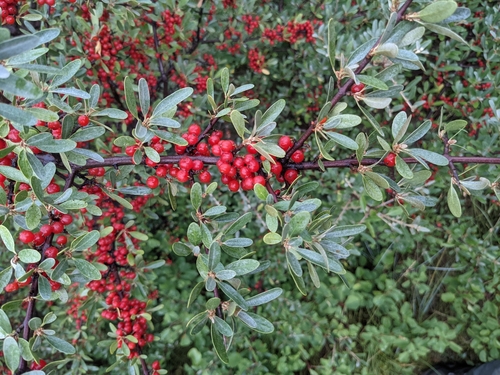
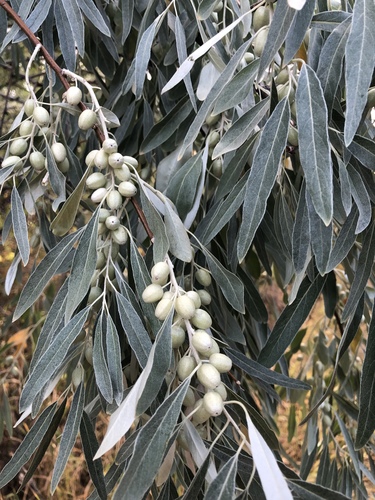
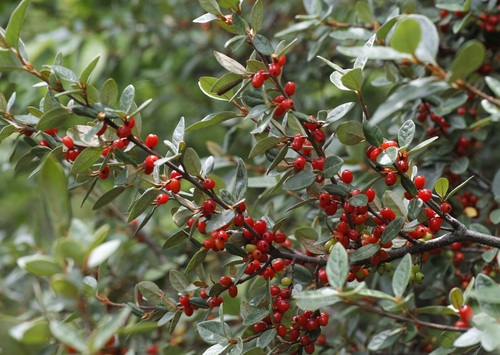
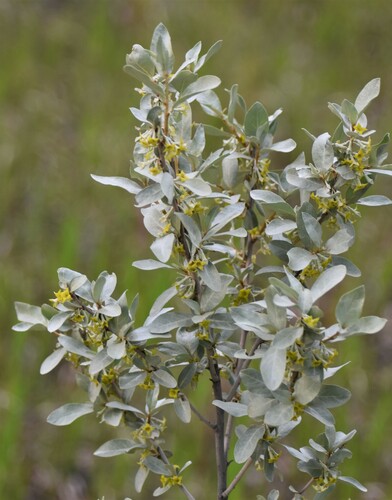
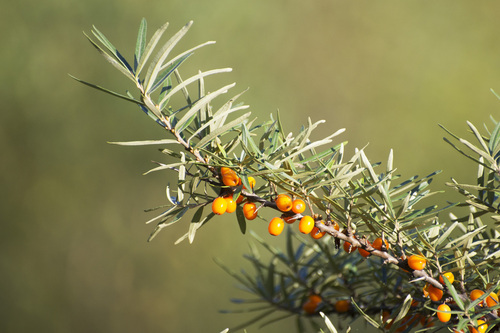
Hippophae rhamnoides L., commonly known as sea-buckthorn, is a hardy deciduous suckering shrub. It typically grows 2 to 5 metres (6 ft 7 in to 16 ft 5 in) tall, and rarely reaches up to 15 metres (49 ft). It forms extensive clonal colonies from root sprouts. It has rough brown or black bark and a thick crown of greyish-green foliage. Like many species in the Elaeagnaceae family, its young shoots and leaves are covered in small silvery scales. The leaves are alternate, narrow, and lanceolate, measuring 1 to 8 cm long and up to 1 cm broad. When young, both leaf surfaces are silvery-green. Through the summer, the upper leaf surface darkens to a mid to dark grey-green as the scales wear off, while the underside remains silvery. Sea-buckthorn is dioecious, meaning male and female flowers grow on separate individual shrubs. The sex of seedlings cannot be identified until the first flowering, which most often occurs after three years of growth. The male inflorescence holds four to six apetalous flowers, while the female inflorescence usually consists of just one apetalous flower, containing one ovary and one ovule. Fertilization happens entirely via wind pollination, so male plants must grow close to female plants for fertilization and fruit production to occur. The fruit are globose to oval, 6 to 8 mm in diameter, and grow in dense, compact clusters. They are typically bright orange, but can range in colour from pale yellow to dark orange. Individual fruits weigh between 270 and 480 mg. Sea-buckthorn has a well-developed, extensive root system. Its roots form a symbiotic relationship with nitrogen-fixing Frankia bacteria, and also convert insoluble organic and mineral compounds in soil into more soluble forms. Vegetative reproduction occurs quickly through root suckers. Hippophae rhamnoides is native to cold-temperate regions of Europe and Asia, located between 27° and 69°N latitude and 7°W and 122°E longitude. Native locations include the North Sea coasts of Great Britain, the Netherlands, and Denmark; the Baltic coasts of Finland, Poland, Latvia, and Germany; the Gulf of Bothnia in Sweden; and additional coastal areas of the United Kingdom and the Netherlands. In Asia, it is found in northern China, across most of the Himalayan region including India, Nepal, Bhutan, Pakistan, and Afghanistan. It grows in a wide range of habitats: hills and hillsides, valleys, riverbeds, coastal regions, and islands. It can grow in small isolated stands, continuous pure stands, or mixed stands alongside other shrub and tree species. In recent times, it has also been planted in countries including Canada, the United States, Bolivia, Chile, Japan, and South Korea. The total global area occupied by both wild and cultivated Hippophae rhamnoides is approximately 3.0 million hectares. Around 2.5 million hectares of this total is located in China, which is made up of 1.0 million hectares of wild plants and 1.5 million hectares of cultivation. Other areas include 20 000 hectares in Mongolia, 12 000 hectares in India, and 3 000 hectares in Pakistan. This makes China the largest agricultural producer of the species. China plants approximately 10 000 acres of sea-buckthorn each year for both berry production and eco-environmental improvement. As of 2003, Canada planted approximately 100 km of field shelterbelts of the species annually, and over 250 000 mature fruit-producing sea-buckthorn plants were grown on the Canadian prairies, with an estimated annual fruit supply of 750 000 kg. Germany and France are among other countries that grow Hippophae rhamnoides as an agricultural crop. Sea-buckthorn provides habitat for many wildlife species. Its dense thickets offer shelter, while its nutrient-dense berries act as a food source for birds and small mammals. Berries are eaten by thrushes (particularly fieldfares), warblers such as blackcaps and common whitethroats, and larger species like magpies. In regions such as Ladakh, these shrubs support a variety of native wildlife, providing both cover and food for local birds and small mammals. On the Canadian prairies, species including sharp-tailed grouse, grey partridge, and common pheasants depend on sea-buckthorn for food and shelter. Its value as a wildlife habitat has been recorded across multiple regions, highlighting its role in supporting biodiversity. Sea-buckthorn is particularly tolerant of drought and salt, which makes it well-suited for land reclamation, preventing soil erosion, use as shelterbelts, and inclusion in agroforestry systems. These uses are primarily possible due to the species' deep, extensive root system. For example, new agroforestry systems developed in eastern China to reclaim high-salinity land include Hippophae rhamnoides as a shelterbelt, which also provides habitat for various birds and small mammals. Hippophae rhamnoides is widely used in traditional medicine, especially in Russia and Northeast Asia. Its leaves are used as an herbal remedy for a range of disorders. In traditional Austrian medicine, sea-buckthorn fruit has also been used internally as tea, juice, or syrup to treat infections. Sea-buckthorn leaves and fruit residues left after oil extraction can be used to feed livestock. The pomace leftover from fruit processing can also be used as animal feed, for example for poultry. Livestock and poultry that eat feed containing sea-buckthorn have been shown to gain considerably more weight. Sea-buckthorn oil is used to produce cosmetics including hand cream, shampoo, and massage oils. Because it tolerates heavily eroded, nutrient-poor, and sometimes salty soils, the species is also used for land reclamation and as a shelterbelt. All parts of the plant contain nutrients, which supports its uses beyond ecological restoration. Its leaves contain significant levels of protein, making them suitable for inclusion in livestock and pet food.