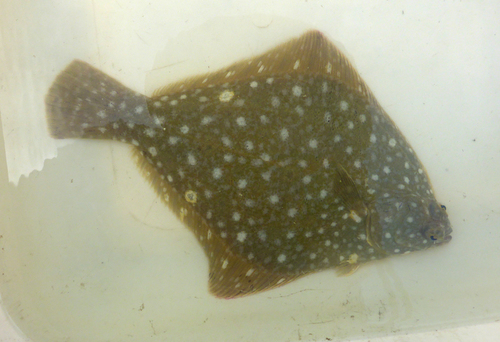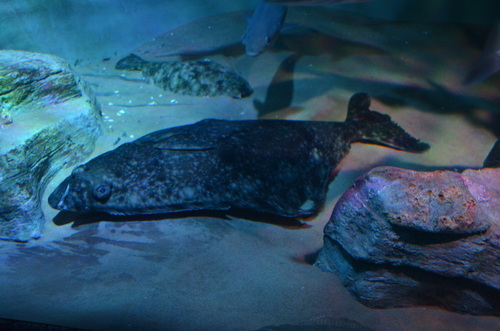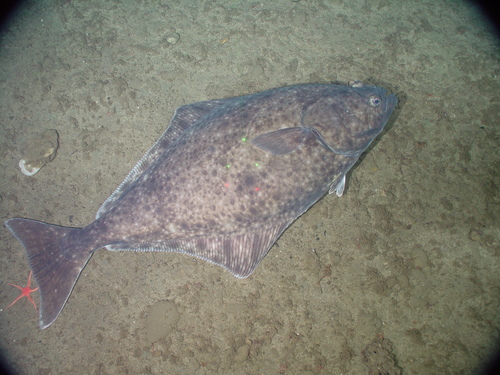
About Hippoglossus stenolepis Schmidt, 1904
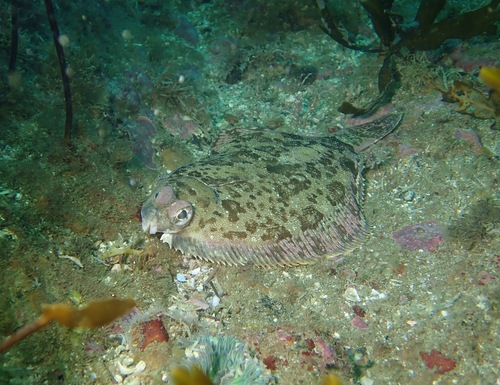
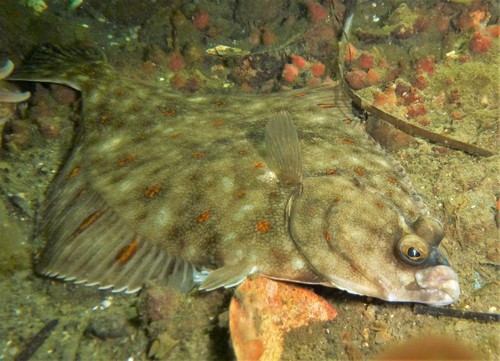
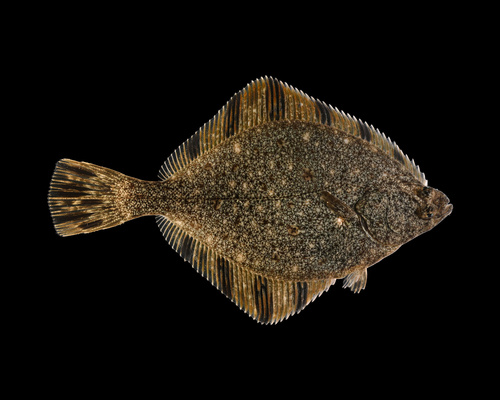
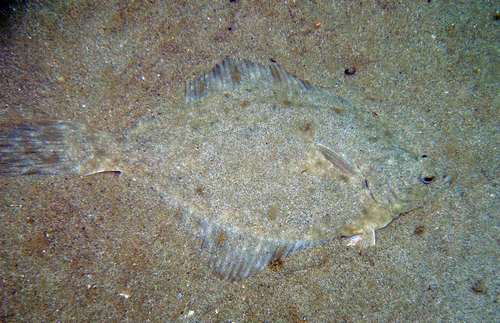
Pacific halibut (Hippoglossus stenolepis Schmidt, 1904), a member of the family Pleuronectidae, have diamond-shaped bodies. They are more elongated than most other flatfishes, with a body width equal to roughly one-third of their body length. Their lateral line forms a high arch over the pectoral fin, and they have a lunate, or crescent-shaped, tail — a trait that sets them apart from other flatfishes. Small scales are embedded in their skin. Like other flatfish, both of their eyes sit on their dark-colored upper side. The color of this dark upper side varies, but typically matches the color of the local ocean bottom, while their underside is a lighter shade that resembles the sky when viewed from below. This camouflaging coloration helps Pacific halibut avoid detection by both their prey and predators. Pacific halibut are one of the largest flatfish species, and only the closely related Atlantic halibut grows larger than them. Females can reach up to 230 kg (510 lb) in weight and over 2.4 m (8 ft) in length. There are unconfirmed reports of individuals reaching 363 kg (800 lb), and a photograph exists of a 1956 catch near Pelican, Alaska that is rumored to be a 430 kg (950 lb), 3.5 m (11 ft) Pacific halibut. The largest recorded sport-caught Pacific halibut weighed 208.2 kg (459 lb), caught in 1996 at Dutch Harbour near Unalaska, Alaska. The oldest recorded individuals of both sexes were 55 years old. This species is found on the continental shelf of the North Pacific Ocean and Bering Sea. Commercial fishing effort for Pacific halibut is concentrated mostly in the Gulf of Alaska, the Bering Sea, and off the west coast of Canada. Small catches also occur regularly in coastal waters of Washington, Oregon, and California. The management of this species divides its range into 10 regular management areas. Pacific halibut are demersal fish that live on or near the seafloor, and prefer water temperatures between 3 and 8 °C (37.4 to 46.4 °F). Pacific halibut are strong swimmers capable of long-distance migrations. All age and size classes participate in a predominantly clockwise migration (from the northwest to the southeast) starting from their settlement areas in the western Gulf of Alaska and Bering Sea. Reproductively mature individuals also make regular seasonal migrations, moving from shallow summer feeding grounds to deeper winter spawning grounds. From November to March each year, mature halibut gather on spawning grounds along the edge of the continental shelf, at depths between 183 to 457 m (600 to 1,500 ft). Spawning occurs during the winter, with peak spawning activity between December and February, taking place mostly along the continental shelf edge at these depths. Males reach sexual maturity at 7 to 8 years of age, while females reach sexual maturity between 8 to 12 years of age. Depending on their size, females lay between 0.5 to 4.0 million eggs each year. Fertilized eggs hatch after approximately 15 days. The resulting free-floating larvae float for up to six months, and can be carried several hundred miles by counter-clockwise North Pacific currents. During this free-floating stage, young halibut undergo multiple developmental changes, including the migration of the left eye to the right side of their body. During this period, young halibut rise to the surface and are carried into shallower water by prevailing currents. By six months old, halibut have developed their full adult form, and measure approximately 3.6 cm (1.4 in) long. Once they reach shallower water, young halibut begin life as bottom-dwellers. Most young halibut spend five to seven years in productive, shallow nursery habitats like the Bering Sea. Young halibut are highly migratory, and generally migrate clockwise east and south across the Gulf of Alaska. Older age classes are less migratory, but still continue to move predominantly in a clockwise direction. Mature fish also make winter spawning migrations into deeper water, and in some cases these migrations cross multiple management areas. Small localized spawning populations can occur in deep waters such as Chatham Strait in northern Southeast Alaska. However, due to the free-floating nature of larvae that mixes juvenies from across the entire Gulf of Alaska, only one genetic stock of Pacific halibut is known to exist in the North Pacific. Growth rates vary by location and habitat conditions, but females consistently grow faster than males.