About Hippodamia convergens Guérin-Méneville, 1842
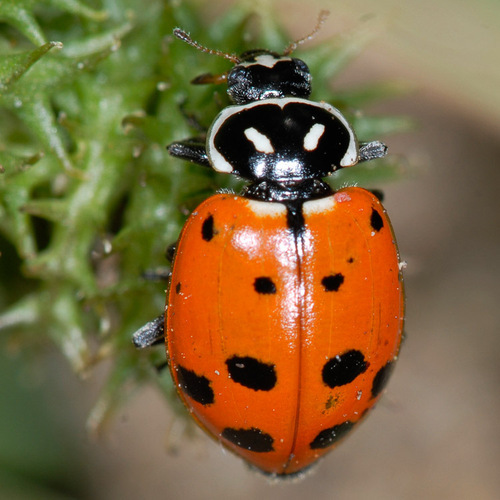
Hippodamia convergens Guérin-Méneville, 1842, commonly called the convergent lady beetle, is one of the most common lady beetle species found across the entire continent of North America. It occupies a wide range of habitats, including grasslands, forests, agricultural fields, gardens, and national parks. The species is native to North America, but individuals imported from California have since become established in South America. Warmer temperatures increase the success rate and likelihood of survival to adulthood for H. convergens. Its minimum temperature tolerance is 6.5°C (approximately 43°F), and its maximum temperature tolerance is 50°C (approximately 122°F). Optimal reproduction and survival occur at 25.12°C (approximately 77°F) with 63.78% relative humidity. In some regions, after moving from wheat fields, these beetles gather in sunflower patches. They hydrate by using sunflower petioles, especially during dry arid summer months. Females can lay over 1000 eggs over several months during spring or early summer; typical clutch counts fall between 200 and 1000 total eggs over this period. Eggs are small, spindle-shaped, laid in upright batches of 15 to 30 eggs close to their prey source. The larvae are dark and have an alligator-like shape. Once they start feeding, larvae grow quickly and molt four times over a period of up to one month. Larvae usually move between plants by traveling across leaves, but they can cross via soil if leaves are not connected. The pupal stage lasts approximately one week, and mating occurs shortly after adult eclosion. If food is abundant, females can begin laying eggs around a week after mating; if food is scarce, they may delay egg laying for up to nine months. After reaching adulthood, females feed on fats and proteins for one week. This diet boosts juvenile hormone production, which supports ovary maturation, and also triggers long-distance migration behavior. In the western United States, these beetles may spend up to nine months in diapause in large aggregations in mountain valleys. When food resources are limited, some H. convergens populations enter diapause to delay reproduction. During diapause, they use limited available food to develop fat bodies and postpone reproduction until a consistent, sufficient food source is available. Adult females are known to actively fly while in diapause. H. convergens feeds on soft-bodied insects, with aphids as its primary food source. Since aphids are common agricultural pests, H. convergens is used for aphid biological control: the beetles are released to act as aphid predators.