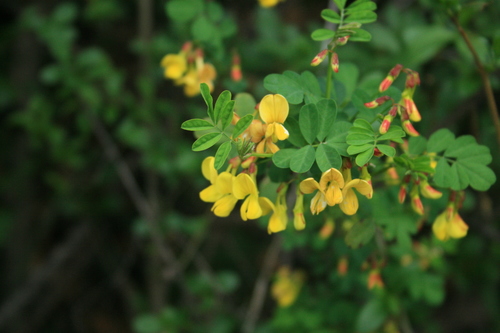
About Hippocrepis emerus (L.) Lassen
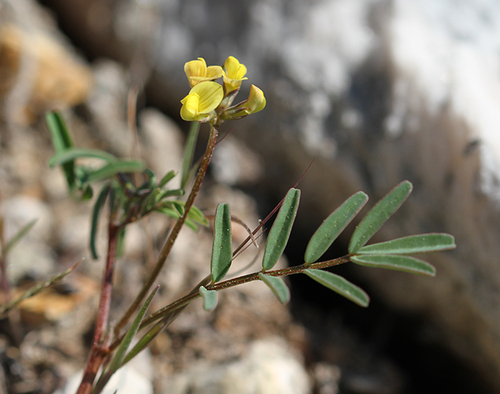
Hippocrepis emerus (L.) Lassen grows to an average height of 50–150 centimetres (20–59 in), and can reach a maximum height of 200 centimetres (79 in). It has a lignified stem and green branches that bear leaves with five to nine leaflets. Its leaves are glossy, obovate, and imparipinnate, with their maximum width located above the middle and often have larger extremities. Pale yellow flowers of this species grow in groups of 1 to 5, and measure 14–20 millimetres (0.55–0.79 in) long. The petals of these flowers are "nailed," meaning they have a long "nail" handle and a "plate". The petal nails are two to three times longer than the calyx. Hippocrepis emerus plants are hermaphroditic and pollinated by insects, with a flowering period running from April to July. Their seed pods (legumes) are oblong-cylindrical, 5–11 centimetres (2.0–4.3 in) long, and contain three to twelve segments. This species grows in northeastern Spain, central Mediterranean countries, extending as far as northern Europe, Asia Minor, and Tunisia. These shrubs are typically found in wooded and bushy areas, on sunny, warm, dry slopes, and around forest edges, at altitudes ranging from 0 to 1,850 metres (0 to 6,070 ft). Hippocrepis emerus is one of the main host plants for the moth Zygaena ephialtes.