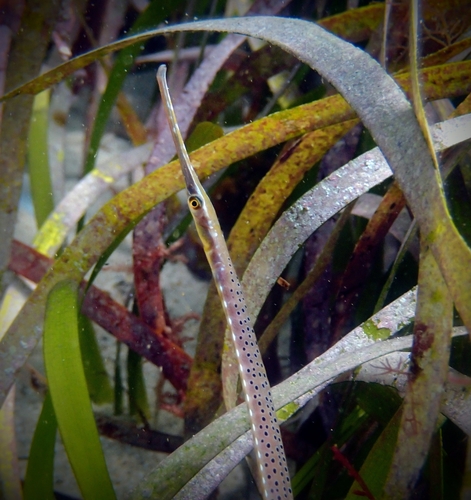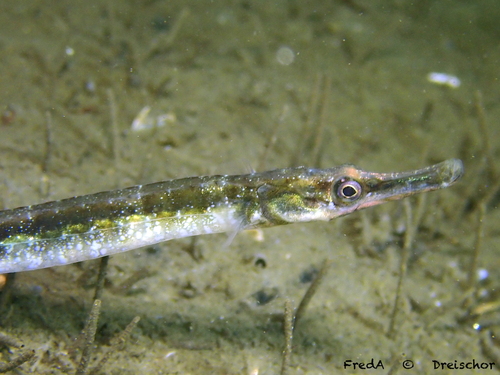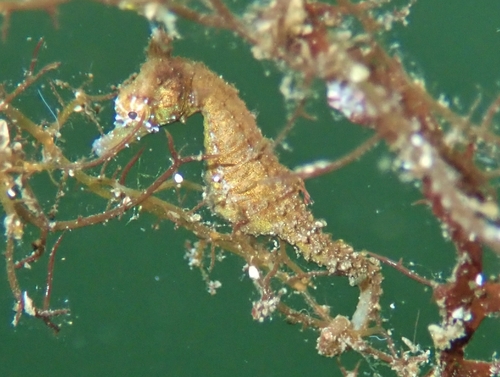
About Hippocampus zosterae Jordan & Gilbert, 1882
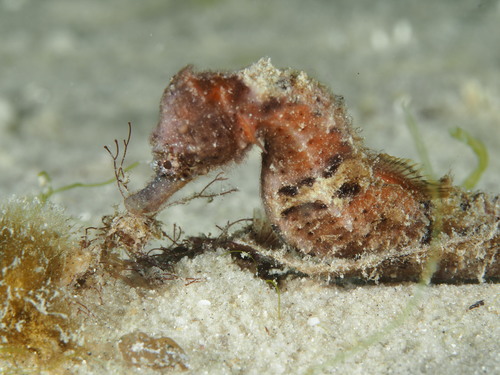
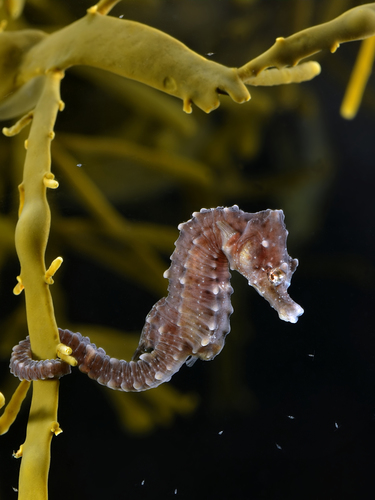
Like other seahorses, the dwarf seahorse (Hippocampus zosterae) has a head angled at a right angle to its body, and swims upright. It uses its dorsal fin for propulsion and its pectoral fins for steering. It reaches an average length of 2 to 2.5 cm (0.8 to 1.0 in), with a maximum recorded length of 5.0 cm (2.0 in). Dwarf seahorses can live up to 2 years, though most individuals live around 1 year. Their coloration includes beige, yellow, green, and black, and they may have white speckles, dark spots, or protrusions. Their coloration typically matches the gorgonian they are typically found on, giving them effective camouflage. This species is able to change color, and has been observed changing color for multiple reasons: camouflage, reaction to an attack, illness, and mating. H. zosterae can be told apart from other western Atlantic seahorse species such as H. reidi and H. erectus by its number of fin rays. This species has 10 to 13 dorsal and pectoral fin rays, and 9 to 10 trunk rings. Fully grown adult H. zosterae are also usually smaller than these two related species. H. zosterae is found in the western Atlantic Ocean, specifically in the coastal Gulf of Mexico, Bahamas, Bermuda, the Florida Keys, Florida’s east coast, Old Tampa Bay, Lemon Bay, Pensacola, and Texas. They are almost entirely restricted to shallow water seagrass microhabitats, and are particularly associated with seagrasses of the genus Zostera. They are most common in high-salinity bays, coral reefs, floating vegetation, and between the roots of mangrove swamps. They often live in pairs, and sometimes live alone. Males are fairly sedentary, and occupy a small home range of around 1 square metre (11 sq ft). Females, by contrast, roam across other males’ territories in a home range around one hundred times larger than that of males. Like all other seahorse species, male dwarf seahorses carry the developing offspring, but males still compete for access to mates. During competition for a female, males engage in tail wrestling, snap their heads toward each other, and produce clicking sounds. The species performs an elaborate courtship dance that begins each morning until copulation occurs. Females initiate courtship behavior by entering the male’s territory. Once she has entered his territory, the male begins the active courtship behavior. In the first courtship phase, the male and female both change color and take turns quivering. This phase lasts for one to two mornings before copulation. All later courtship phases occur on the day of copulation. During the second phase, the female holds a pointing posture with her head pointed upward. In response, the male quivers and displays pumping behaviors. In the third phase, the male takes on the pointing posture in response to the female’s posture. In the final courtship phase, the pair repeatedly rises into the water column. The male pumps his tail toward his body, and eventually the pair intertwine their tails. During the final rise in the water column, the female inserts her ovipositor and transfers eggs into the male’s brood pouch. After eggs are deposited, the male rocks back and forth to settle the eggs into his pouch. Males carry between 3 and 55 developing young in their brood pouch for around 10 days before releasing them. Newly born dwarf seahorses are 7 to 9 mm long, while the eggs inside the brood pouch have a diameter of around 1.3 mm. While females could technically mate with multiple males, dwarf seahorses form strict monogamous pair bonds that last for at least an entire breeding season, a trait that is rare among fish species. During the male’s pregnancy, the female remains faithful and returns to the male’s territory each day for an early morning greeting. During this greeting, the pair changes color and dances together for around 6 minutes. Adult dwarf seahorses are iteroparous, meaning they have multiple reproductive cycles over their lifetime; for this species, this works out to 2 reproductive cycles per month. Dwarf seahorses remate within 4 to 20 hours after the male releases his young, and this can happen throughout the breeding season. The breeding season starts in mid-February and ends in late October, with timing that depends on day length and water temperature.