About Hippocampus trimaculatus Leach, 1814
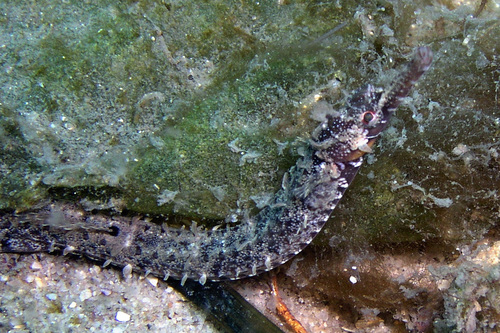
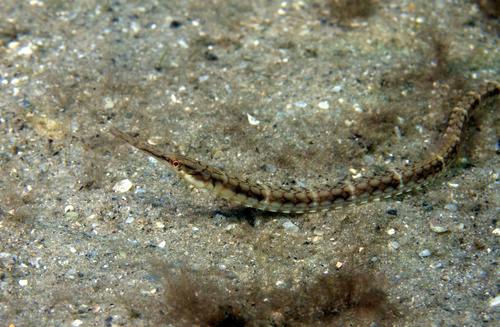
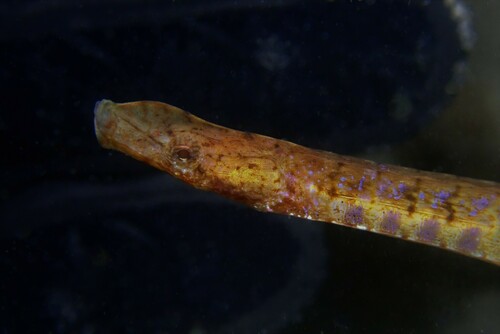
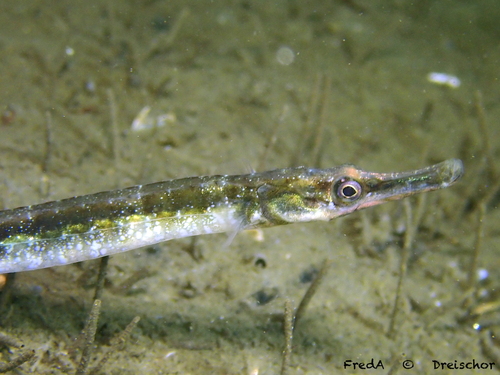
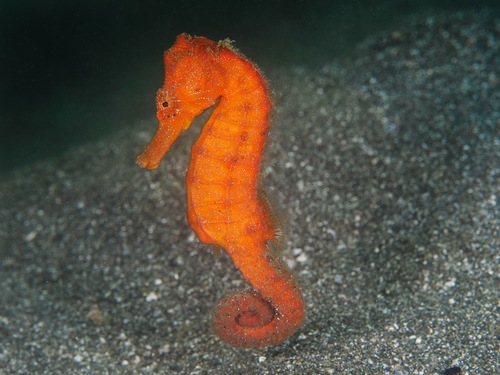
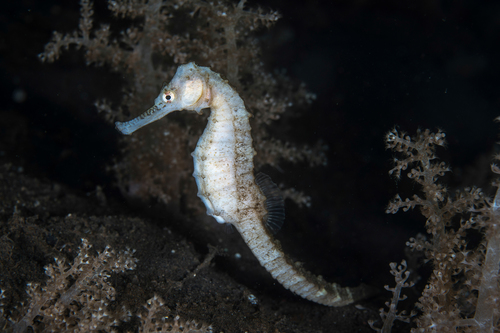
The longnose seahorse, whose scientific name is Hippocampus trimaculatus, also has multiple common names: flat-faced seahorse, low-crowned seahorse, and three-spot seahorse. This species is primarily found in shallow seas surrounding Australia and Asia. It feeds on plankton and small crustaceans, which it sucks in through its snout. Like typical seahorse behavior, this species anchors itself to seagrass while feeding to save energy. While its appearance can vary across individuals, the species typically has a flat body, sharp hook-shaped cheek and eye spines, a narrow head, and no nose spines. Its body color can be golden orange, sandy, or completely black; some individuals even have brown and white zebra-like stripes. On average, males of this species are slightly longer than females. Longnose seahorses are usually found at depths between 10 and 100 meters. Recently, however, juvenile flat-faced seahorses were observed at a depth of less than 0.1 meters in the Malacca Strait. This observation may be the first record of drifting juvenile seahorses in this area, and it provides potentially strong evidence that this species performs passive long-distance migration. This seahorse generally lives on gravel or sand bottoms around coral reefs, in muddy estuaries, and near mangroves, and it can also survive in brackish water. The flat-faced seahorse is classified as a vulnerable species and is threatened by habitat loss. Several factors contribute to its vulnerability. Large numbers of this species are part of the millions of seahorses traded internationally each year, and they are also frequently caught as bycatch. Harvested seahorses are commonly used in traditional Chinese medicine, dried and sold as souvenirs in the United States, and sold as pets worldwide. These unsustainable harvesting and trade practices led the Convention on International Trade in Endangered Species of Wild Fauna and Flora (CITES) to propose restrictions on seahorse trade. While these restrictions are not legally binding, traders must follow them to earn sustainable certification. The key restriction prohibits harvesting any seahorse smaller than 10 cm. This size restriction is particularly relevant because of how flat-faced seahorses reach sexual maturity. For this species, sexual maturity is predicted more accurately by size than by age. For example, populations in the South China Sea and North China Sea both reach sexual maturity at the same size, but South China Sea individuals reach maturity at 3 months old, while North China Sea individuals reach maturity at 5 months old. Unlike many other seahorse species that reach maturity after growing larger than 10 cm, flat-faced seahorses reach sexual maturity before they reach 10 cm in length. During mating, female flat-faced seahorses transfer their eggs to males, who carry the eggs and give birth to live young. The gestation period for this species ranges from 11 to 20 days, with an average of 16 days. The length of gestation varies with water temperature: the species has a 19-day gestation period at 22.5°C, 16 days at 24°C, and 11 days at 28.5°C, which matches the pattern seen in other Hippocampus genus members. While captive flat-faced seahorses can reproduce year-round, wild populations in the China Sea have a peak breeding season from March to May. Their peak breeding season may vary by location, because the species’ reproduction depends on consistent water temperature.