About Hippocampus spinosissimus Weber, 1913
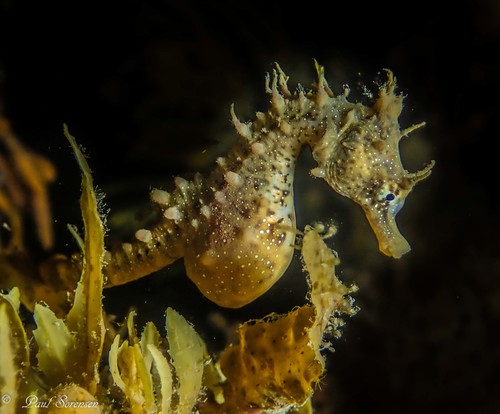
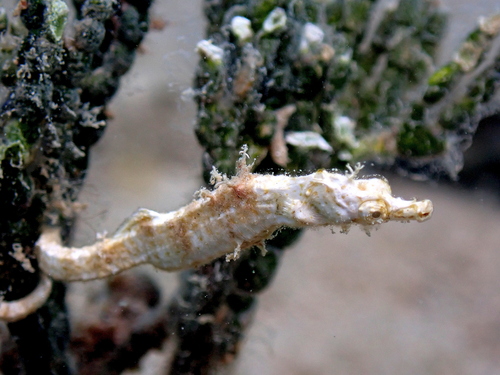
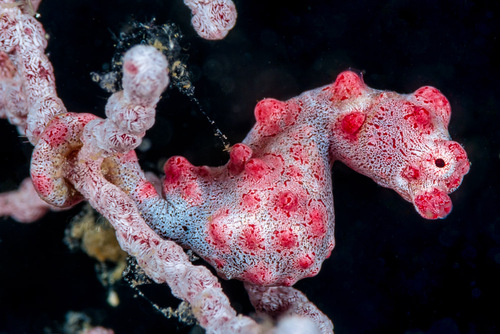
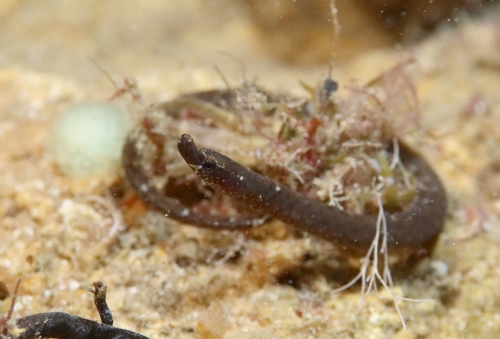
For identification, Hippocampus spinosissimus is usually around 12.5 centimetres (4.9 inches) long. It has a long snout and a low coronet. Its body spines change in prominence over its lifetime, with juveniles being more spiny than adults. Individuals typically have a yellow-orange to deep red or dark brown snout, a dark front of the head, and pale grey saddle-shaped markings or bands across the trunk and tail. Specimens found in deep water are usually red or orange, which likely helps them match the sponges and corals that grow at that depth. For habitat, Hippocampus spinosissimus lives in reef systems, occupying areas with sand or silt bottoms, and can be found down to a maximum depth of 70 metres (230 feet). In the central Philippines, individuals are most often found on relatively barren soft or sandy bottoms and in depressions, where they live alongside octocorals, sea stars, sea pens, sea urchins, sponges, submerged wood, and macroalgae. They are rarely found living directly on reefs or with hard corals. Data from trawls in Malaysia shows this species has similar habitat preferences there. For reproduction and growth, Hippocampus spinosissimus is an ovoviviparous species. The female uses an ovipositor to transfer eggs into an enclosed brood pouch located on the male's stomach. The male then fertilizes the eggs, protects the developing embryos, and eventually gives birth to tiny independent young that measure 5.63 millimetres (0.222 inches) long. Individuals reach sexual maturity when they are roughly 10.4 centimetres (4.1 inches) long.