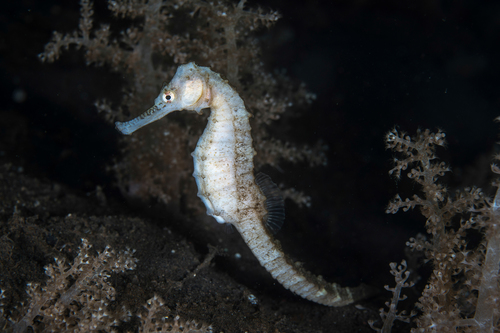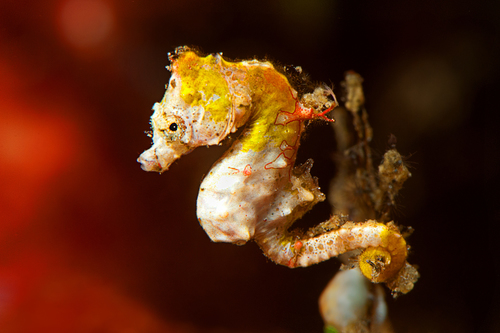
About Hippocampus reidi Ginsburg, 1933
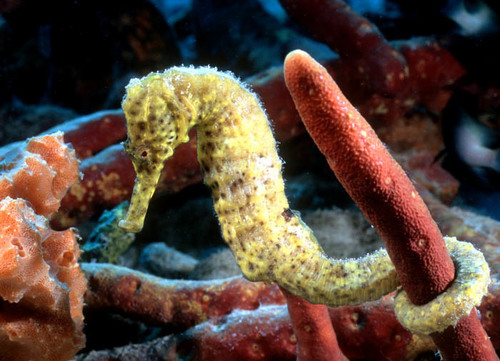
Description: Slender seahorses (Hippocampus reidi) have a gestation period of around two weeks. Adults typically grow to approximately 6.8 inches (17.5 centimeters) long, while the average height of juvenile slender seahorses is only around 8.2 millimeters. Males are usually orange, and females are typically yellow. Both sexes may have sporadic brown or white spots across their bodies. During the courtship period, these spots may change color to pink or white. Habitat and distribution: This seahorse species has been recorded at depths up to 55 meters (180 feet), and smaller individuals live in shallower waters. Slender seahorses prefer coral reefs and seagrass beds, and can be found on gorgonian coral, in seagrass, among mangroves, and in Sargassum. It is native to the Bahamas, Barbados, Belize, Bermuda, Brazil, Colombia, Cuba, Grenada, Haiti, Honduras, Jamaica, Panama, the United States (Florida and North Carolina), and Venezuela. It lives in subtropical regions, ranging from 29 degrees north to 25 degrees south latitude, and 133 degrees west to 40 degrees east longitude. The species is common in China, and even more common in Brazil, but it is at risk of becoming endangered in both regions. In China, these seahorses are traded and used in traditional Chinese medicine. In Brazil, they are heavily traded, with commercial extraction reaching 25 million seahorses per year.